Find area, surface area and volume with the formula sheet
Learn what perimeter, area, surface area and volume each measure, how to read the GED® formula sheet, and how to work with rectangles, triangles, circles, composite shapes, boxes, cylinders, cones and spheres. Includes eight original questions with worked answers.
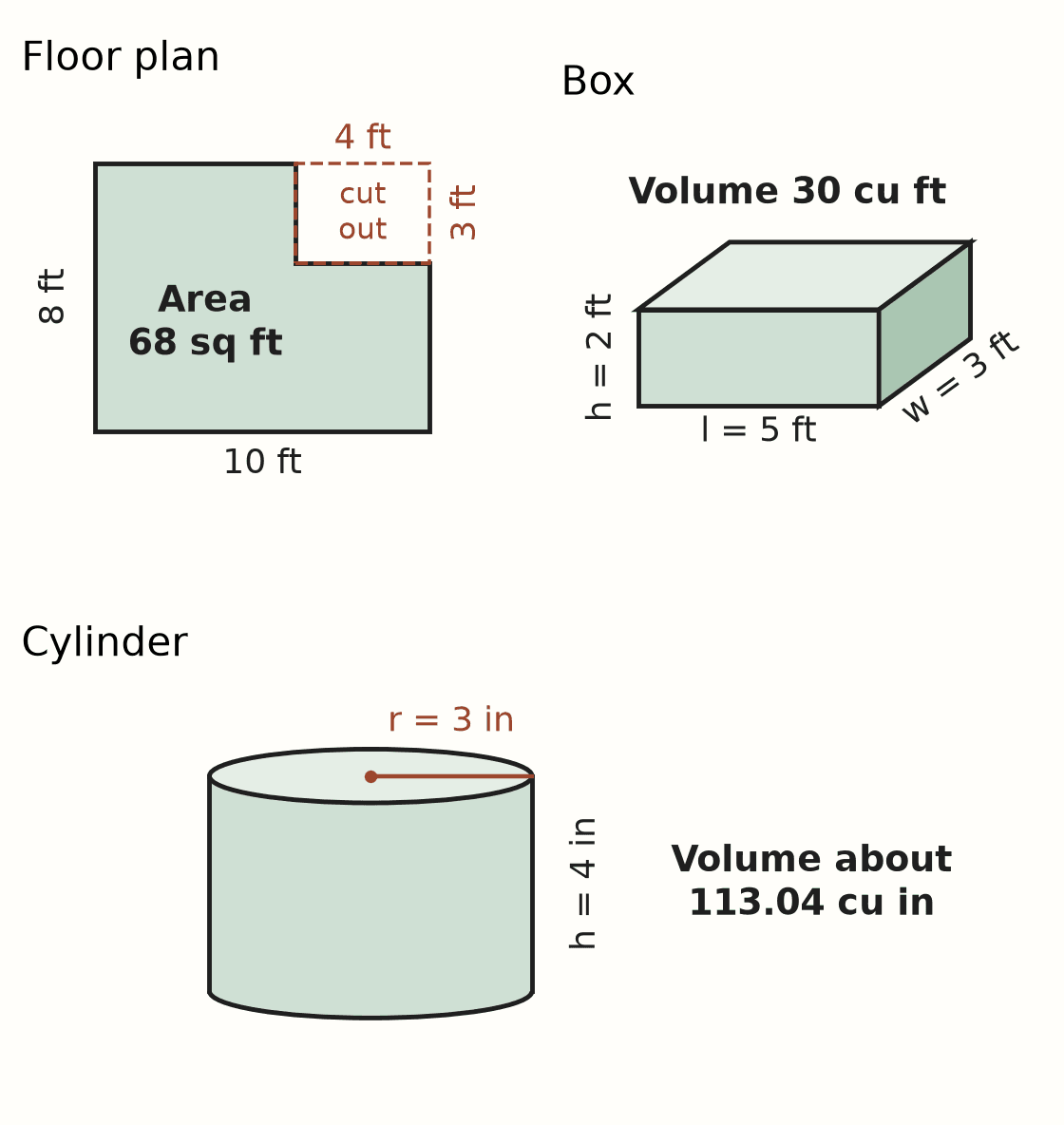
| Shape | Measurements | Formula and result |
|---|---|---|
| L-shaped floor | 10 ft by 8 ft rectangle minus a 4 ft by 3 ft corner | A = lw twice: 80 − 12 = 68 square feet |
| Box | l = 5 ft, w = 3 ft, h = 2 ft | V = lwh: 5 × 3 × 2 = 30 cubic feet |
| Cylinder | r = 3 in, h = 4 in | V = πr²h: 3.14 × 9 × 4 = 113.04 cubic inches |
Four different measurements
Perimeter is the distance around a flat shape, such as the fence around a yard. It is a length, so its units are plain units: feet, meters, inches.
Area is the space a flat shape covers, such as the carpet for a floor. It is measured in square units: square feet (ft²), square meters (m²).
Volume is the space inside a solid, such as the water a tank holds. It is measured in cubic units: cubic feet (ft³), cubic inches (in³). Surface area is the total area of all the outside faces of a solid, such as the cardboard needed to make a box. Like any area, it is in square units.
Before you pick a formula, ask: am I going around, covering, or filling? Then check that your answer has the matching unit.
How to use the formula sheet
On the GED® math test you can use a formula sheet. It lists area formulas (square, rectangle, parallelogram, triangle, trapezoid, circle), perimeter formulas, the circumference of a circle, and surface area and volume formulas for a rectangular prism, right prism, cylinder, pyramid, cone and sphere. It says to use π ≈ 3.14.
The sheet does not tell you which formula fits a problem, and it does not explain the letters. Learn them now: l is length, w is width, h is height, b is a base length, r is the radius (center to edge), d is the diameter (all the way across, so d = 2r), and s on the cone and pyramid lines is the slant height, measured along the sloping side. A capital B means the area of the base, and p means the perimeter of the base.
A good routine: (1) name the shape, (2) find its line on the sheet, (3) write down what each letter equals in your problem, (4) substitute and calculate, (5) add the unit.
Flat shapes: rectangles, triangles and circles
Rectangle: A = lw and P = 2l + 2w. A room 12 ft by 9 ft has area 12 × 9 = 108 square feet and perimeter 2(12) + 2(9) = 42 feet.
Triangle: A = ½bh, where h is the height straight up from the base, not a slanted side. A triangle with base 8 cm and height 5 cm has area ½ × 8 × 5 = 20 square cm.
Circle: A = πr² and C = 2πr or C = πd. A circle with radius 5 in has area 3.14 × 5 × 5 = 78.5 square inches and circumference 2 × 3.14 × 5 = 31.4 inches. If you are given the diameter, halve it before you use A = πr².
You can also work backward. A rectangle with area 48 square feet and length 8 feet has width 48 ÷ 8 = 6 feet. A circle with circumference 31.4 inches has diameter 31.4 ÷ 3.14 = 10 inches, so its radius is 5 inches.
For a right triangle, the Pythagorean theorem a² + b² = c² finds a missing side, where c is the longest side. Legs of 5 and 12 give c² = 25 + 144 = 169, so c = 13.
Composite shapes: split or subtract
A composite shape is made of simpler shapes. Either split it into pieces and add their areas, or start with a bigger shape and subtract the missing part.
In the floor-plan diagram, the floor is a 10 ft by 8 ft rectangle with a 4 ft by 3 ft corner cut out. Subtract: 10 × 8 − 4 × 3 = 80 − 12 = 68 square feet. Splitting gives the same answer: a 10 ft by 5 ft strip (50) plus a 6 ft by 3 ft piece (18) is 68.
If a shape includes half a circle, find the whole circle's area and divide by 2. Always check that you did not count any piece twice or leave one out.
Boxes and cylinders: volume and surface area
Rectangular prism (a box): V = lwh and SA = 2lw + 2lh + 2wh. The box in the diagram is 5 ft by 3 ft by 2 ft, so V = 5 × 3 × 2 = 30 cubic feet. Its surface area is 2(15) + 2(10) + 2(6) = 30 + 20 + 12 = 62 square feet: two of each pair of matching faces.
Cylinder: V = πr²h. That is the area of the circle on the bottom times the height. The cylinder in the diagram has r = 3 in and h = 4 in, so V = 3.14 × 9 × 4 = 113.04 cubic inches. Its surface area is SA = 2πrh + 2πr² = 2(3.14)(3)(4) + 2(3.14)(9) = 75.36 + 56.52 = 131.88 square inches.
Any right prism follows the same idea: V = Bh, the area of the base times the height. Working backward: a box holds 96 cubic inches and its base is 4 in by 3 in, so 12h = 96 and the height is 8 inches.
Cones, pyramids and spheres
A cone or pyramid holds one third as much as a cylinder or prism with the same base and height. That is why their volume formulas have ⅓: V = ⅓πr²h for a cone and V = ⅓Bh for a pyramid. A cone with r = 3 cm and h = 4 cm has V = ⅓ × 3.14 × 9 × 4 = 37.68 cubic cm, one third of the 113.04 for the matching cylinder.
Use the height h (straight up through the middle) for volume, and the slant height s for surface area. They are different lengths.
Sphere (a ball): V = (4/3)πr³ and SA = 4πr². A ball with radius 3 in has surface area 4 × 3.14 × 9 = 113.04 square inches. Its volume is (4/3) × 3.14 × 27 = 113.04 cubic inches. The numbers match only because r = 3; the units still differ.
Where this comes from
Where this comes from: GED Testing Service’s Assessment Guide for Educators: Mathematical Reasoning lists target Q.4, “calculate dimensions, perimeter, circumference, and area of two-dimensional figures” (including composite figures and the Pythagorean theorem), and target Q.5, “calculate dimensions, surface area, and volume of three-dimensional figures,” for prisms, cylinders, pyramids, cones, spheres and composite solids, when given geometric formulas. The guide places quantitative problem solving in measurement at about 20 percent of the GED® Mathematical Reasoning test and says the formula sheet is available during the entire math test. The formulas in this lesson match the GED Testing Service formula sheet. We checked both on October 20, 2026.
These sources set the topic. The explanations, diagrams and questions here are original FinishHigh practice, not GED® test questions. GED® is a registered trademark of the American Council on Education. FinishHigh is independent and not affiliated with or endorsed by it. This lesson teaches one starting skill. It is not a full course or an official readiness result.
Next, try the questions below with the formula sheet open beside you. Write down one formula letter you mixed up, such as r and d, so you can check it again tomorrow.
Your turn.
Try each question before opening the explanation. These are FinishHigh practice examples, not GED® test questions.
A garden is 12 feet long and 7 feet wide. Find its perimeter and its area.
Show the answer and why
Perimeter: 2(12) + 2(7) = 24 + 14 = 38 feet. Area: 12 × 7 = 84 square feet. Perimeter is a length; area is in square units.
A triangle has a base of 14 inches and a height of 5 inches. What is its area?
Show the answer and why
35 square inches. A = ½bh = ½ × 14 × 5 = 35.
A round rug has a diameter of 8 feet. Using π ≈ 3.14, find its area and its circumference.
Show the answer and why
The radius is half the diameter: 4 feet. Area: 3.14 × 4 × 4 = 50.24 square feet. Circumference: 3.14 × 8 = 25.12 feet.
A patio is a 10 ft by 6 ft rectangle with a half circle on one 6 ft side. Using π ≈ 3.14, what is its total area?
Show the answer and why
74.13 square feet. Rectangle: 10 × 6 = 60. The half circle has diameter 6, so r = 3. Whole circle: 3.14 × 9 = 28.26; half is 14.13. Total: 60 + 14.13 = 74.13.
A box is 6 inches long, 4 inches wide and 3 inches tall. Find its volume and its surface area.
Show the answer and why
Volume: 6 × 4 × 3 = 72 cubic inches. Surface area: 2(6 × 4) + 2(6 × 3) + 2(4 × 3) = 48 + 36 + 24 = 108 square inches.
A water tank is a cylinder with radius 2 feet and height 5 feet. Using π ≈ 3.14, how much water can it hold?
Show the answer and why
62.8 cubic feet. V = πr²h = 3.14 × 2 × 2 × 5 = 62.8.
A box holds 120 cubic centimeters. Its base is 6 cm by 5 cm. How tall is it?
Show the answer and why
4 cm. V = lwh, so 120 = 6 × 5 × h = 30h. Divide by 30: h = 4.
A cone-shaped cup has radius 3 cm and height 6 cm. Using π ≈ 3.14, what is its volume?
Show the answer and why
56.52 cubic cm. V = ⅓πr²h = ⅓ × 3.14 × 9 × 6 = ⅓ × 169.56 = 56.52.
Trusted sources and further study
Sources guide the topics and factual information. The lesson wording, examples, and questions are original FinishHigh material.
- Official math formula sheet ↗GED Testing Service · checked 2026-10-07
- Math: official assessment targets for educators ↗GED Testing Service · checked 2026-10-21
Another small step
Independent practice, not the GED® test or a pass guarantee. Aid and admission depend on the provider’s rules.
Choose your next free lesson ↗