Place fractions on a number line, one equal step at a time
Count equal spaces, place fractions beyond one, and compare values without guessing from the bottom number. Includes seven original questions with worked answers.
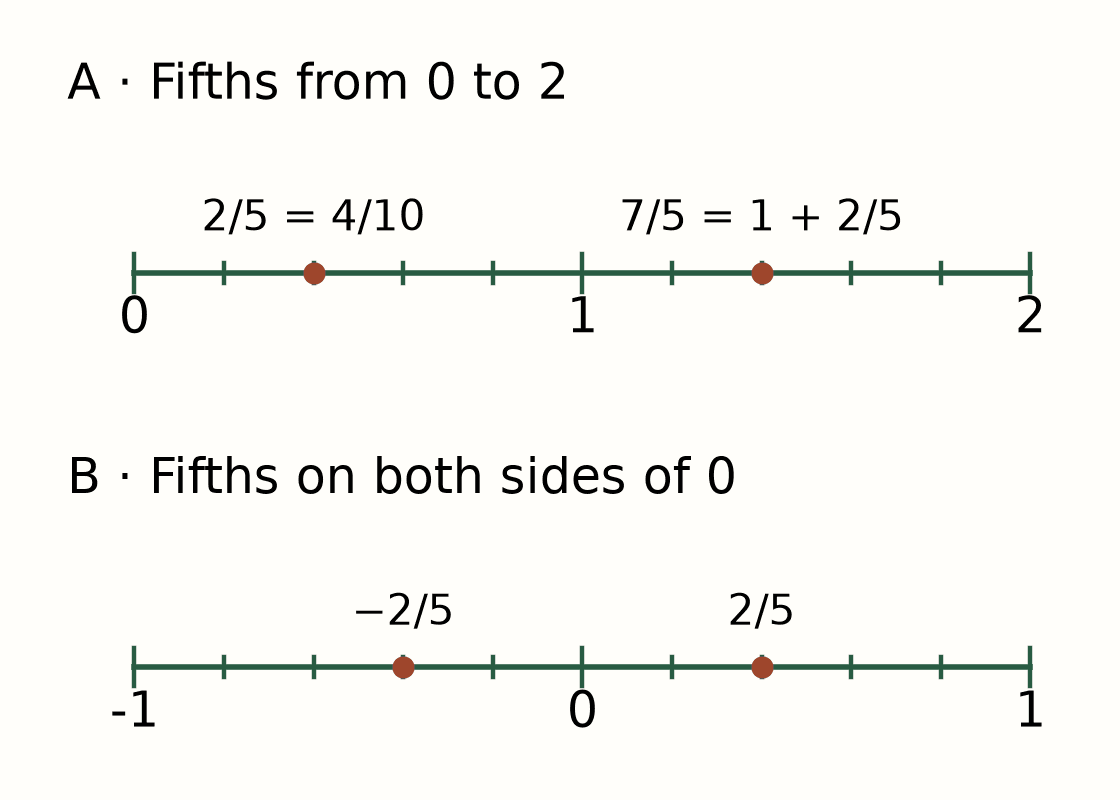
| Marked point | Position | Meaning |
|---|---|---|
| A: 2/5 = 4/10 | 0.4 | Two fifth-sized steps right of 0 |
| A: 7/5 = 1 + 2/5 | 1.4 | Seven fifth-sized steps right of 0 |
| B: −2/5 | −0.4 | Two fifth-sized steps left of 0 |
| B: 2/5 | 0.4 | Two fifth-sized steps right of 0 |
Find the whole unit before counting
A number line puts smaller values to the left and larger values to the right. First find 0 and 1. The distance between them is one whole unit. On Line A, the distance from 1 to 2 is another whole unit of the same size.
A fraction such as 2/5 means two parts when each whole is split into five equal parts. The bottom number, 5, is the denominator: it sets the size of each part. The top number, 2, is the numerator: it counts how many of those parts you have. Here the denominator is positive and cannot be zero.
Count spaces, not all the marks
To place 2/5, split the distance from 0 to 1 into five equal spaces. Start at 0 and move two spaces right. Put a dot there. Do not count the starting mark as your first step.
Five spaces need six boundary marks when you include 0 and 1. There are four marks inside that unit. A common mistake is drawing five marks total and accidentally making only four spaces. Count the gaps to check your drawing. Unequal gaps do not represent equal fifths.
Different fraction names can share one point
The point labeled 2/5 on Line A is also 4/10. Split each fifth-sized space into two smaller spaces: the whole then has ten equal spaces, and the same dot is four spaces from 0. Multiplying both numbers by 2 gives 2/5 = 4/10.
A different denominator does not always mean a different value. Keep the same whole unit when comparing. A drawing of two fifths of one unit and four tenths of a larger unit would not be a fair comparison of lengths.
Keep going beyond one
A fraction can be greater than one. For 7/5, take seven fifth-sized steps right of 0. Five steps reach 1 because 5/5 = 1. Two more reach 1 + 2/5, also written as the mixed number 1 2/5. A mixed number combines a whole number and a fraction.
Do not squeeze all seven fifths into the space from 0 to 1. That would change the size of the parts. The unit from 1 to 2 has the same five equal spaces as the unit from 0 to 1.
Compare positions, not just denominators
To compare 2/5 and 1/2, rewrite both in tenths: 2/5 = 4/10 and 1/2 = 5/10. Four equal steps are fewer than five, so 2/5 is smaller. The point for 1/2 would be halfway between 0 and 1, slightly to the right of 2/5.
When positive fractions have the same numerator, more equal parts in a whole means smaller parts. For example, 1/6 is smaller than 1/3. But this shortcut does not work for every pair with different numerators. Equivalent fractions or a correctly labeled number line give a safer check.
For a negative fraction, move left of zero
On Line B, −2/5 is two fifth-sized steps left of 0. Positive 2/5 is the same distance to the right. Both are between −1 and 1. Their distances from 0 are equal, but their values are different.
The left point is always the smaller value on an ordinary number line. Thus −2/5 is smaller than −1/5, even though it is farther from zero. Count from zero in the direction the sign tells you.
Try this short drawing routine
On paper, draw a straight line, mark 0 and 1, choose equal spaces for the denominator, and count from 0. Extend by whole units if needed. Label the dot, then check it against nearby whole numbers. If you change the denominator, keep the whole-unit length unchanged.
The GED.com Math subject page lists comparing fractions and decimals as a sample skill. OpenStax provides further instruction on fraction models and number lines. These sources guide the topic; the diagrams, wording and questions here are original, independent practice. This lesson is a starting skill, not a full course or an official readiness result.
After the questions, try the related percentage or ratio lesson below. Write down one mistake you corrected so you can check it again tomorrow.
Your turn.
Try each question before opening the explanation. These are FinishHigh practice examples, not GED® test questions.
How many equal spaces and how many boundary marks, including 0 and 1, do you need to divide one unit into fifths?
Show the answer and why
Five equal spaces and six boundary marks. The four inside marks plus the two endpoints make six. Count the gaps between marks, not the marks themselves.
Starting at 0 on Line A, what fraction is at the third small mark to the right?
Show the answer and why
3/5. Each space is 1/5 of a unit. Three steps from 0 give 1/5 + 1/5 + 1/5 = 3/5. The starting mark at 0 is not a step.
Do 2/5 and 4/10 need separate dots? Explain using equal spaces.
Show the answer and why
No. They name the same point. Splitting each fifth into two tenths makes two fifths into four tenths: 2/5 = (2 × 2)/(5 × 2) = 4/10. The whole unit stays the same size.
Where is 7/5: between 0 and 1, between 1 and 2, or between 2 and 3? Write it as a mixed number.
Show the answer and why
Between 1 and 2. Five fifths make 1, with two fifths left: 7/5 = 5/5 + 2/5 = 1 2/5. Seven fifth-sized steps from 0 reach that point.
Which is farther right: 2/5 or 1/2? Show a comparison in tenths.
Show the answer and why
1/2 is farther right. Convert 2/5 to 4/10 and 1/2 to 5/10. Since 5/10 is greater than 4/10, 1/2 is greater than 2/5. Compare equal-sized parts.
Which is smaller: −2/5 or −1/5? Use the direction from 0.
Show the answer and why
−2/5 is smaller. It is two fifth-sized steps left of 0; −1/5 is only one step left. The value farther left is smaller, even though its distance from 0 is greater.
On a walking-distance line, 0, 1, 2 and 3 mark kilometers, with each kilometer split into five equal spaces. What distance is three small steps after 2?
Show the answer and why
2 3/5 kilometers, which is 13/5 kilometers. Two whole kilometers are 10/5; add 3/5 to get 13/5. It lies between 2 and 3 kilometers. Each small step is one fifth of a kilometer, not one kilometer.
Trusted sources and further study
Sources guide the topics and factual information. The lesson wording, examples, and questions are original FinishHigh material.
- Math: GED® test topic guidance ↗GED Testing Service · checked 2026-10-14
- OpenStax: visualize fractions on a number line ↗OpenStax, Rice University · checked 2026-10-14
Another small step
Independent practice, not the GED® test or a pass guarantee. Aid and admission depend on the provider’s rules.
Choose your next free lesson ↗