Polynomials, factoring and quadratic equations
Add, subtract and multiply polynomials, factor them, and solve quadratic equations by factoring, by square roots or with the quadratic formula. Ends with an area story. Includes eight original questions with worked answers.
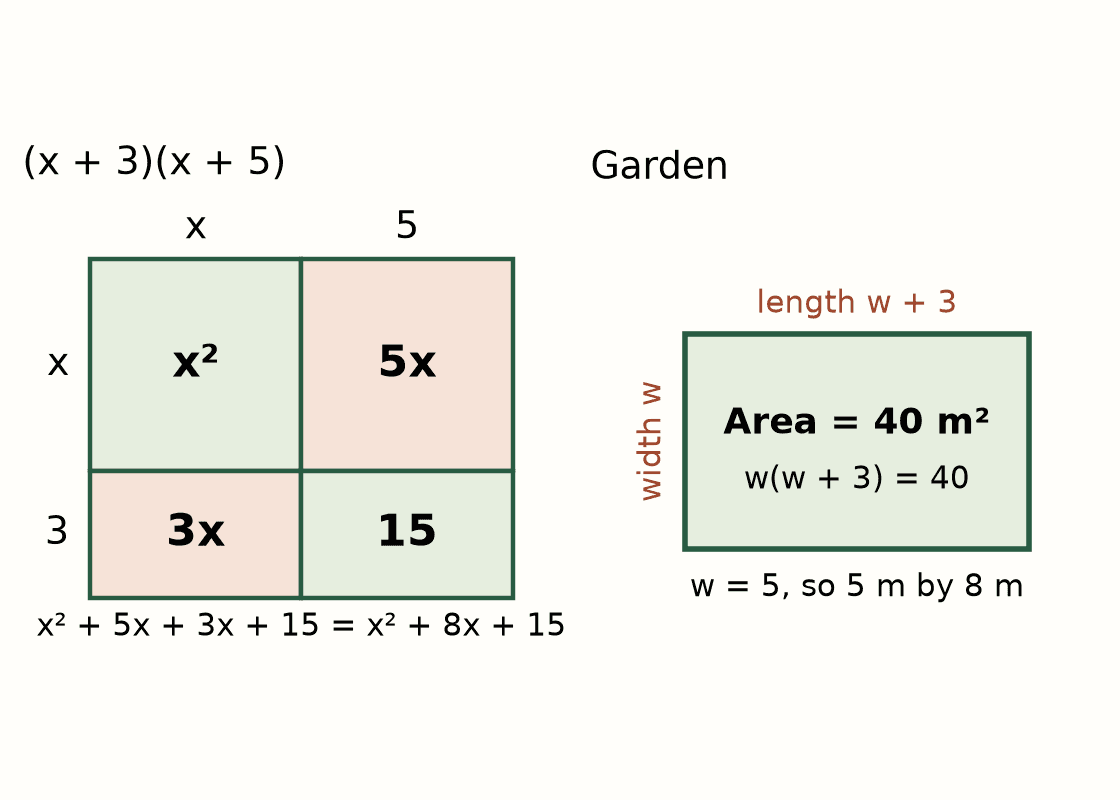
| Part | Size | Area |
|---|---|---|
| Top-left box | x by x | x² |
| Top-right box | x by 5 | 5x |
| Bottom-left box | 3 by x | 3x |
| Bottom-right box | 3 by 5 | 15 |
| Whole rectangle | (x + 3) by (x + 5) | x² + 8x + 15 |
| Garden | w by (w + 3), with w = 5 | 5 × 8 = 40 square meters |
Terms, like terms and polynomials
A term is a number, a letter, or numbers and letters multiplied together, such as 7, 4x or −3x². A polynomial is one or more terms added or subtracted, such as 3x² + 2x − 5. A quadratic is a polynomial whose highest power is x².
Like terms have the same letter raised to the same power. 3x² and −x² are like terms. 3x² and 3x are not, because the powers are different. You can only combine like terms. Add or subtract their numbers and keep the letter part the same.
To add polynomials, combine like terms: (3x² + 2x − 5) + (x² − 6x + 4) = 4x² − 4x − 1. To subtract, change the sign of every term in the second polynomial first, then combine: (5x² − x + 2) − (2x² + 3x − 7) = 5x² − x + 2 − 2x² − 3x + 7 = 3x² − 4x + 9. Forgetting to change every sign is the most common mistake.
To evaluate a polynomial, put the number in for x. For 2x² − 3x + 1 when x = −2: 2(−2)² − 3(−2) + 1 = 2(4) + 6 + 1 = 15.
Multiply two binomials
A binomial has two terms, such as x + 3. To multiply two binomials, multiply each term in the first by each term in the second, then combine like terms. The left-hand diagram shows (x + 3)(x + 5) as a rectangle. Its four boxes are x², 5x, 3x and 15. Added together: x² + 8x + 15.
Another example: (2x − 1)(x + 4) = 2x·x + 2x·4 − 1·x − 1·4 = 2x² + 8x − x − 4 = 2x² + 7x − 4. A single term times a polynomial works the same way: 3x(x − 4) = 3x² − 12x.
Quick check: pick a number, such as x = 1, and try both forms. (1 + 3)(1 + 5) = 24, and 1 + 8 + 15 = 24. If the two results do not match, look for a mistake.
Factor: undo the multiplication
Factoring writes a polynomial as a product. Always look for a common factor first. In 6x² + 9x, both terms can be divided by 3x, so 6x² + 9x = 3x(2x + 3).
To factor x² + bx + c, find two numbers that multiply to c and add to b. For x² + 7x + 12, the numbers 3 and 4 multiply to 12 and add to 7, so it factors as (x + 3)(x + 4). For x² − 2x − 15, the numbers −5 and 3 multiply to −15 and add to −2, so it factors as (x − 5)(x + 3).
A difference of two squares has a shortcut: x² − 49 = (x − 7)(x + 7). Always check by multiplying back. Factoring also helps you divide: (x² + 7x + 12) ÷ (x + 3) = x + 4, because x² + 7x + 12 = (x + 3)(x + 4).
Solve a quadratic equation by factoring
If two numbers multiply to 0, at least one of them must be 0. That fact lets you solve a factored equation. First move everything to one side so the other side is 0.
Example: solve x² − 5x − 14 = 0. The numbers −7 and 2 multiply to −14 and add to −5, so (x − 7)(x + 2) = 0. Then x − 7 = 0 or x + 2 = 0, so x = 7 or x = −2. Check 7: 49 − 35 − 14 = 0. Check −2: 4 + 10 − 14 = 0.
If the equation is not set to 0, fix that first. For x² + 3x = 10, subtract 10: x² + 3x − 10 = 0. Then (x + 5)(x − 2) = 0, so x = −5 or x = 2. A quadratic usually has two answers, so look for both.
Solve with square roots
When there is an x² but no plain x term, get x² by itself and take the square root of both sides. Remember that both a positive and a negative number square to the same result. If x² = 49, then x = 7 or x = −7, because 7² = 49 and (−7)² = 49.
Example: 3x² − 12 = 0. Add 12: 3x² = 12. Divide by 3: x² = 4. So x = 2 or x = −2. This works for a squared group, too: if (x − 3)² = 16, then x − 3 = 4 or x − 3 = −4, so x = 7 or x = −1.
Use the quadratic formula
Some quadratics do not factor nicely. The quadratic formula always works. Write the equation as ax² + bx + c = 0, then x = (−b ± √(b² − 4ac)) ÷ (2a). The ± means you get one answer with plus and one with minus.
Example: 2x² + 3x − 2 = 0, so a = 2, b = 3 and c = −2. First find b² − 4ac = 9 − 4(2)(−2) = 9 + 16 = 25, and √25 = 5. Then x = (−3 + 5) ÷ 4 = 1/2 or x = (−3 − 5) ÷ 4 = −2.
Example that does not factor: x² − 4x − 1 = 0, so a = 1, b = −4 and c = −1. Then b² − 4ac = 16 + 4 = 20, and x = (4 ± √20) ÷ 2. On a calculator, √20 is about 4.47, so x is about 4.24 or about −0.24. Be careful with signs: −b is −(−4) = 4.
Write a quadratic from an area story
A garden is a rectangle. Its length is 3 meters more than its width, and its area is 40 square meters. Let w be the width. Then the length is w + 3, and area = width × length, so w(w + 3) = 40.
Multiply out and set it to 0: w² + 3w − 40 = 0. Factor: (w + 8)(w − 5) = 0, so w = −8 or w = 5. A width cannot be negative, so the width is 5 meters and the length is 8 meters. Check: 5 × 8 = 40. Always read the answers back into the story and keep only the ones that make sense.
Where this comes from
Where this comes from: GED Testing Service’s Assessment Guide for Educators: Mathematical Reasoning lists target A.1, “write, evaluate, and compute with expressions and polynomials,” and target A.4, “write, manipulate, and solve quadratic equations.” This lesson covers adding, subtracting and multiplying polynomials, including two binomials, and dividing factorable ones (A.1.d), evaluating polynomials (A.1.e), factoring (A.1.f), writing polynomials from a situation (A.1.g), solving quadratic equations with real solutions by factoring, square roots or the quadratic formula (A.4.a), and writing a quadratic equation from a story (A.4.b). The guide places expressions and equations at about 30 percent of the GED® Mathematical Reasoning test, within the algebraic half of about 55 percent. The guide’s formula sheet lists the quadratic formula, so you do not need to memorize it, but you do need to know how to use it. We checked the guide on October 20, 2026.
These sources set the topic. The explanations, diagrams and questions here are original FinishHigh practice, not GED® test questions. GED® is a registered trademark of the American Council on Education. FinishHigh is independent and not affiliated with or endorsed by it. This lesson teaches one starting skill. It is not a full course or an official readiness result.
Next, try the questions below. This is a big topic, so it is fine to do it over two or three short sessions. Write down one mistake you fixed so you can check it again tomorrow.
Your turn.
Try each question before opening the explanation. These are FinishHigh practice examples, not GED® test questions.
Try this next
The equation is x² = 36. There is no plain x term. What is the best next step?
Simplify (4x² − 3x + 7) + (2x² + 5x − 9).
Show the answer and why
6x² + 2x − 2. Combine like terms: 4x² + 2x² = 6x², −3x + 5x = 2x, and 7 − 9 = −2.
Simplify (6x² + 2x − 1) − (x² − 4x + 3).
Show the answer and why
5x² + 6x − 4. Change every sign in the second group: 6x² + 2x − 1 − x² + 4x − 3. Then combine: 6x² − x² = 5x², 2x + 4x = 6x, and −1 − 3 = −4.
Multiply (x + 6)(x − 2).
Show the answer and why
x² + 4x − 12. Multiply each term by each term: x·x = x², x·(−2) = −2x, 6·x = 6x, and 6·(−2) = −12. Combine −2x + 6x = 4x. Check with x = 1: (7)(−1) = −7, and 1 + 4 − 12 = −7.
Factor 5x² − 20x completely.
Show the answer and why
5x(x − 4). Both terms can be divided by 5x: 5x² ÷ 5x = x and 20x ÷ 5x = 4. Check: 5x(x − 4) = 5x² − 20x.
Factor x² + 9x + 20.
Show the answer and why
(x + 4)(x + 5). The numbers 4 and 5 multiply to 20 and add to 9. Check: (x + 4)(x + 5) = x² + 5x + 4x + 20 = x² + 9x + 20.
Solve x² − x − 12 = 0.
Show the answer and why
x = 4 or x = −3. The numbers −4 and 3 multiply to −12 and add to −1, so (x − 4)(x + 3) = 0. Check 4: 16 − 4 − 12 = 0. Check −3: 9 + 3 − 12 = 0.
Solve 2x² = 50.
Show the answer and why
x = 5 or x = −5. Divide both sides by 2: x² = 25. Both 5 and −5 square to 25. Check: 2(5²) = 2(25) = 50, and 2((−5)²) = 50.
Use the quadratic formula to solve x² + 6x + 2 = 0. Round each answer to the nearest hundredth.
Show the answer and why
x ≈ −0.35 or x ≈ −5.65. Here a = 1, b = 6 and c = 2. Then b² − 4ac = 36 − 8 = 28, so x = (−6 ± √28) ÷ 2. √28 is about 5.29. So x ≈ (−6 + 5.29) ÷ 2 ≈ −0.35, or x ≈ (−6 − 5.29) ÷ 2 ≈ −5.65. (Exact answers: −3 ± √7.)
Trusted sources and further study
Sources guide the topics and factual information. The lesson wording, examples, and questions are original FinishHigh material.
- Math: GED® test topic guidance ↗GED Testing Service · checked 2026-10-14
- Math: official assessment targets for educators ↗GED Testing Service · checked 2026-10-21
Another small step
Independent practice, not the GED® test or a pass guarantee. Aid and admission depend on the provider’s rules.
Choose your next free lesson ↗