Read a fiction passage: character, setting, word choice and theme
Use five questions to read any story excerpt on the GED® language arts test: who, where, what changes, how it is told and what it suggests. Practice on two public-domain American stories by Kate Chopin and Jack London. Includes six questions with worked answers.
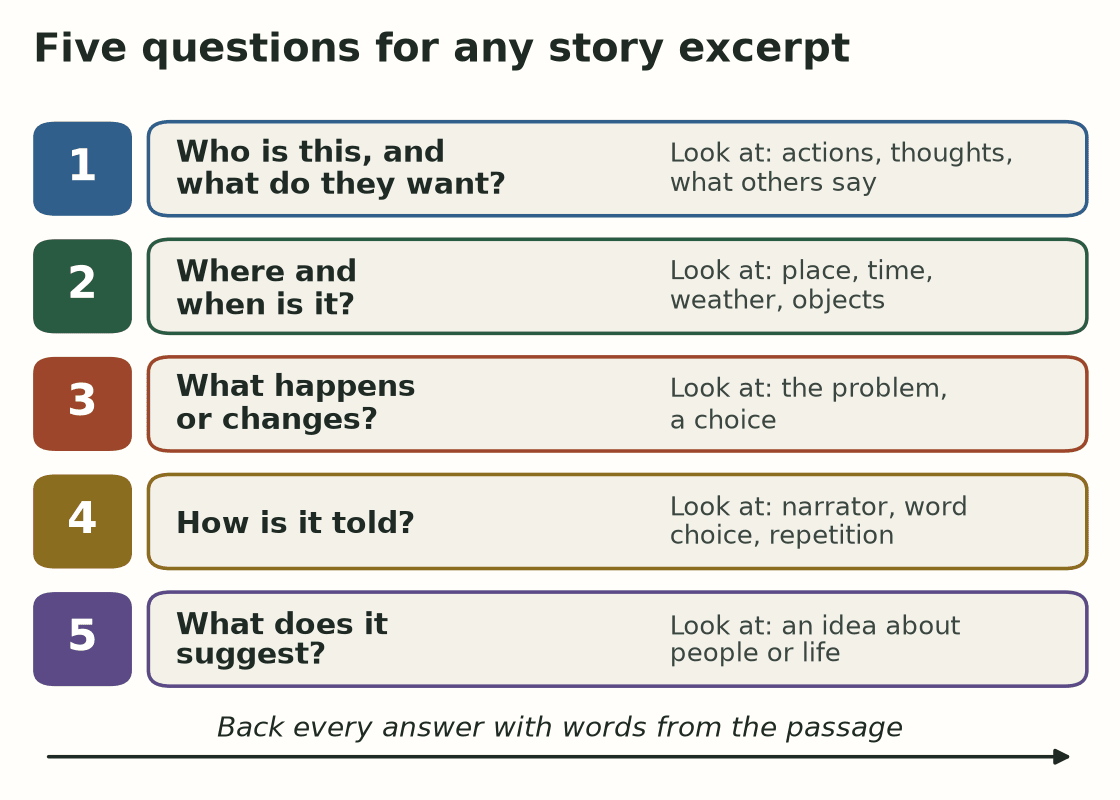
| Question | What to look for | Example from this lesson |
|---|---|---|
| Who is this, and what do they want? | Actions, thoughts, what others say | Mrs. Sommers plans to spend her money on her children. |
| Where and when is it? | Place, time, weather, objects | A trail in the Yukon, cold and grey, with no sun. |
| What happens or changes? | The problem, a choice, a turning point | She suddenly has fifteen dollars and must decide how to use it. |
| How is it told? | Narrator, word choice, repeated words | The narrator says outright that the man is "without imagination." |
| What does it suggest? | A lesson or idea about people | Not seeing danger can be a danger of its own. |
Fiction on the language arts test
The GED® language arts test mixes nonfiction with literary passages: excerpts from stories and novels. GED Testing Service says about a quarter of the reading passages are literary, and that reading passages run about 400 to 900 words.
You do not need to memorize terms like metaphor or foreshadowing. The questions mostly ask what you can figure out from the words on the page: what a character is like and why they act, how the setting matters, what a word means in its sentence, how the passage is built and what idea it suggests. Every answer should point back to words in the passage.
Older stories can feel slow because the sentences are long and some words are out of date. Read once for the basic events, then again with the questions in mind. If a word is new, use the sentence around it.
Five questions to ask of any story excerpt
1. Who is this, and what do they want? Look at what the character does, thinks and says, and how other people talk about them.
2. Where and when is it? Setting is more than a place. Weather, money, time of day and objects all tell you something.
3. What happens or changes? Find the problem or choice the character faces.
4. How is it told? Notice who is telling the story and which words they choose. A narrator can tell you something the character does not know.
5. What does it suggest? The theme is an idea about people or life that the story shows. It is usually not stated in one sentence, and it should fit the whole passage, not one line.
Passage 1: Kate Chopin, "A Pair of Silk Stockings" (1897)
Little Mrs. Sommers one day found herself the unexpected possessor of fifteen dollars. It seemed to her a very large amount of money, and the way in which it stuffed and bulged her worn old porte-monnaie gave her a feeling of importance such as she had not enjoyed for years.
The question of investment was one that occupied her greatly. For a day or two she walked about apparently in a dreamy state, but really absorbed in speculation and calculation. She did not wish to act hastily, to do anything she might afterward regret. But it was during the still hours of the night when she lay awake revolving plans in her mind that she seemed to see her way clearly toward a proper and judicious use of the money.
A dollar or two should be added to the price usually paid for Janie’s shoes, which would insure their lasting an appreciable time longer than they usually did. She would buy so and so many yards of percale for new shirt waists for the boys and Janie and Mag. She had intended to make the old ones do by skilful patching. Mag should have another gown. She had seen some beautiful patterns, veritable bargains in the shop windows. And still there would be left enough for new stockings—two pairs apiece—and what darning that would save for a while! She would get caps for the boys and sailor-hats for the girls. The vision of her little brood looking fresh and dainty and new for once in their lives excited her and made her restless and wakeful with anticipation.
The neighbors sometimes talked of certain “better days” that little Mrs. Sommers had known before she had ever thought of being Mrs. Sommers. She herself indulged in no such morbid retrospection. She had no time—no second of time to devote to the past. The needs of the present absorbed her every faculty. A vision of the future like some dim, gaunt monster sometimes appalled her, but luckily to-morrow never comes.
Source: Kate Chopin, "A Pair of Silk Stockings," first published in Vogue on September 16, 1897. Text from Project Gutenberg ebook #160, The Awakening, and Selected Short Stories. Public domain in the United States because it was first published there before 1931. A porte-monnaie is a small purse; percale is a cotton cloth; shirt waists are blouses.
Reading Passage 1 with the five questions
Who, and what does she want? Mrs. Sommers is poor. Her purse is "worn old," and fifteen dollars feels like "a very large amount of money." Almost all her plans are for her children: shoes for Janie, cloth for shirts, a gown for Mag, stockings, caps and hats. She is careful and selfless. She "did not wish to act hastily."
Where and when? We learn little about the place, but a lot about money and time. She patches old clothes and darns stockings to make them last. The neighbors remember "better days," which suggests her life was once more comfortable.
How is it told? The narrator uses money words: "investment," "speculation and calculation." Those big words for a small sum show how seriously she takes it. The last sentence has a sad joke: she is frightened of the future, "but luckily to-morrow never comes." She copes by not thinking past today.
Words in context: "judicious" means sensible and well-judged, because it sits beside "proper" and follows her careful planning. "Morbid retrospection" means gloomy looking back, because the next sentences say she has no time for the past.
What might happen? The title names silk stockings, a luxury, while her plans are all practical things for her children. A careful reader can predict a conflict between what she plans and what she might want for herself.
Passage 2: Jack London, "To Build a Fire" (1908)
Day had broken cold and grey, exceedingly cold and grey, when the man turned aside from the main Yukon trail and climbed the high earth-bank, where a dim and little-travelled trail led eastward through the fat spruce timberland. It was a steep bank, and he paused for breath at the top, excusing the act to himself by looking at his watch. It was nine o’clock. There was no sun nor hint of sun, though there was not a cloud in the sky. It was a clear day, and yet there seemed an intangible pall over the face of things, a subtle gloom that made the day dark, and that was due to the absence of sun. This fact did not worry the man. He was used to the lack of sun. It had been days since he had seen the sun, and he knew that a few more days must pass before that cheerful orb, due south, would just peep above the sky-line and dip immediately from view.
[…]
But all this—the mysterious, far-reaching hairline trail, the absence of sun from the sky, the tremendous cold, and the strangeness and weirdness of it all—made no impression on the man. It was not because he was long used to it. He was a new-comer in the land, a chechaquo, and this was his first winter. The trouble with him was that he was without imagination. He was quick and alert in the things of life, but only in the things, and not in the significances. Fifty degrees below zero meant eighty odd degrees of frost. Such fact impressed him as being cold and uncomfortable, and that was all. It did not lead him to meditate upon his frailty as a creature of temperature, and upon man’s frailty in general, able only to live within certain narrow limits of heat and cold; and from there on it did not lead him to the conjectural field of immortality and man’s place in the universe. Fifty degrees below zero stood for a bite of frost that hurt and that must be guarded against by the use of mittens, ear-flaps, warm moccasins, and thick socks. Fifty degrees below zero was to him just precisely fifty degrees below zero. That there should be anything more to it than that was a thought that never entered his head.
Source: Jack London, "To Build a Fire," first published in The Century Magazine in August 1908 and collected in Lost Face (Macmillan, 1910). Text from Project Gutenberg ebook #2429, Lost Face. Public domain in the United States because it was first published there before 1931. The second paragraph of the story is left out where you see […]. A pall is a dark covering; a chechaquo (often spelled cheechako) is a newcomer to the far North.
Reading Passage 2 with the five questions
Where and when? The opening repeats "cold and grey" and says there is "no sun nor hint of sun." The day is clear, yet dark. The setting feels heavy and threatening before anything happens.
Who, and what is he like? The man is never named, which makes him feel small next to the land. He is a newcomer in his first winter. The narrator states his problem directly: "he was without imagination." He knows facts, such as fifty below zero, but not what they mean for a human body.
How is it told? The narrator knows more than the man and tells us so. Repeating "Fifty degrees below zero" three times shows how flat his thinking is: to him the number is just a number. The contrast between "the things" and "the significances" is the key idea of the paragraph.
What does it suggest? A careful reader can infer a theme: people are fragile in nature, and not seeing a danger can be a danger of its own. Notice that this is an inference built from several details, not one sentence copied from the text.
Answering test questions about fiction
Read the question, then go back to the lines it points to. Choose the answer the passage supports, not the one that sounds most interesting. Watch for choices that are true in real life but not shown in the passage, and choices that fit one sentence but not the whole excerpt.
For word questions, put each choice into the sentence in place of the word. The right meaning makes the sentence fit what comes before and after.
Where this comes from
Where this comes from: GED Testing Service's Assessment Guide for Educators: Reasoning Through Language Arts says about 25 percent of reading passages are literary texts, and that reading passages range from about 400 to 900 words. Its reading targets include R.3 (how characters, events and ideas develop, including inferences about plot, character and setting), R.4 (word meaning in context, including figurative meaning and tone), R.5 (how a passage is structured) and R.6 (point of view and purpose). We checked the guide on October 20, 2026.
Both excerpts are in the public domain in the United States because they were first published there before 1931, as the Cornell University Library copyright chart shows. Texts are quoted from Project Gutenberg's free ebooks. The explanations, chart and questions here are original FinishHigh practice, not GED® test questions or passages. GED® is a registered trademark of the American Council on Education. FinishHigh is independent and not affiliated with or endorsed by it. This lesson teaches one skill. It is not a full course or an official readiness result.
Next, try the questions below. If finding evidence still feels new, review the lesson "Read the evidence before choosing an opinion" first. Then read the rest of one story at Project Gutenberg and ask the five questions about its ending.
Your turn.
Try each question before opening the explanation. These are FinishHigh practice examples, not GED® test questions.
Passage 1: Which two details show that Mrs. Sommers does not have much money?
Show the answer and why
Any two of these: her purse is "worn old"; fifteen dollars seems "a very large amount of money" to her; she usually makes old clothes "do by skilful patching"; new stockings would save "darning." Each one shows she has to make things last.
Passage 1: What does the sentence "She herself indulged in no such morbid retrospection" tell you about Mrs. Sommers?
Show the answer and why
She does not spend time feeling sad about the past, even though the neighbors talk about her "better days." The next sentences support this: she has "no second of time to devote to the past," and "the needs of the present" take all her attention.
Passage 1: The narrator says she is frightened by the future, "but luckily to-morrow never comes." What does this line suggest about how she copes?
Show the answer and why
She copes by focusing only on today. The line is a gentle joke: tomorrow always arrives, but she avoids worrying about it by keeping busy with present needs. It suggests her calm depends on not looking ahead.
Passage 2: How does the setting in the first paragraph create a mood before anything happens?
Show the answer and why
The narrator repeats "cold and grey," says there is "no sun nor hint of sun," and describes "a subtle gloom that made the day dark." Even on a clear day, the land feels dark and heavy, so the mood is gloomy and threatening.
Passage 2: What does the narrator mean by saying the man was quick "in the things of life, but only in the things, and not in the significances"?
Show the answer and why
He notices facts but not what they mean. He knows it is fifty degrees below zero and that he needs mittens, but he does not think about how fragile a human body is in that cold. The next sentences explain this, ending with "Fifty degrees below zero was to him just precisely fifty degrees below zero."
Both passages: In each excerpt, the narrator tells the reader something the character does not see. Give one example from each passage.
Show the answer and why
Passage 1: the narrator shows that Mrs. Sommers avoids thinking about the future ("luckily to-morrow never comes"), while she simply stays busy. Passage 2: the narrator says the man "was without imagination" and did not think about "man’s frailty," which the man himself never considers. In both, the reader knows more than the character.
Trusted sources and further study
Sources guide the topics and factual information. The lesson wording, examples, and questions are original FinishHigh material.
- Language arts: official assessment targets for educators ↗GED Testing Service · checked 2026-10-20
- Kate Chopin: The Awakening, and Selected Short Stories (Project Gutenberg) ↗Project Gutenberg · checked 2026-10-20
- Jack London: Lost Face, with the story To Build a Fire (Project Gutenberg) ↗Project Gutenberg · checked 2026-10-20
- Cornell University Library: copyright term and the public domain in the United States ↗Cornell University Library · checked 2026-10-20
Another small step
Independent practice, not the GED® test or a pass guarantee. Aid and admission depend on the provider’s rules.
Choose your next free lesson ↗