Read a founding document or landmark Supreme Court case
Turn old, formal government writing into plain words and name the big idea behind it. Practice on short excerpts of the Declaration of Independence, the Constitution, the Bill of Rights, Marbury v. Madison and Brown v. Board of Education. Includes six questions with worked answers.
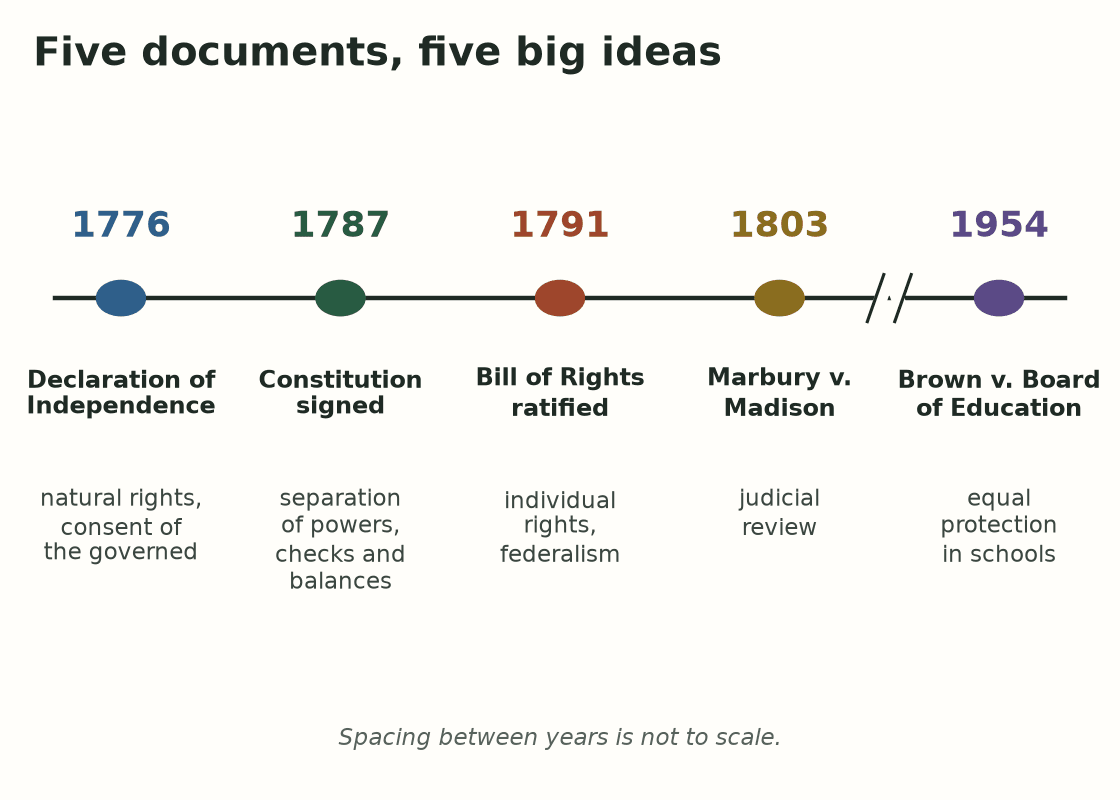
| Year | Document | Big idea |
|---|---|---|
| 1776 | Declaration of Independence | Natural rights; government by consent of the governed |
| 1787 | U.S. Constitution (signed) | Separation of powers; checks and balances |
| 1791 | Bill of Rights (ratified) | Individual rights; powers reserved to the states or the people |
| 1803 | Marbury v. Madison | Judicial review: courts decide what the law is |
| 1954 | Brown v. Board of Education | Equal protection: segregated public schools are unequal |
Why these documents show up on the test
About half of the GED® social studies test is civics and government, and about a fifth is U.S. history. GED Testing Service says many of the short texts come from "the Great American Conversation": founding documents such as the Bill of Rights, analyses of them, and later speeches and court decisions about American citizenship and liberties.
You will not be asked to recite these documents. You will be asked to read an excerpt, say what it means in plain words, and connect it to an idea such as natural rights, consent of the governed, separation of powers, checks and balances, the rule of law, individual rights or federalism.
Four steps for any primary source
1. Source it. Who wrote it, when, and for what purpose? A declaration announcing a break with a king has a different purpose from a court deciding one case.
2. Slow down on the key sentence. Old documents use long sentences, capital letters on ordinary nouns and older spellings, such as "defence" or "shewn." Find the main subject and verb first, then the rest.
3. Put it in plain words. Say the sentence again as if you were explaining it to a friend. If you cannot, read the sentence before and after it.
4. Name the big idea. Ask which principle of government the excerpt shows. Then check that your answer comes from the words on the page, not from what you already believe about today's politics.
Excerpt 1: the Declaration of Independence (1776)
We hold these truths to be self-evident, that all men are created equal, that they are endowed by their Creator with certain unalienable Rights, that among these are Life, Liberty and the pursuit of Happiness.--That to secure these rights, Governments are instituted among Men, deriving their just powers from the consent of the governed,
Plain words: People are born with rights that no one can take away, including life, liberty and the pursuit of happiness. Governments exist to protect those rights, and a government gets its rightful power from the people it governs.
Big ideas: natural rights (rights people have simply by being human) and consent of the governed, also called popular sovereignty. Context matters too: in 1776 these words did not protect enslaved people, and most women could not vote. Questions may ask you to tell the ideal in the text apart from the practice of its time.
Excerpt 2: the Constitution (1787)
We the People of the United States, in Order to form a more perfect Union, establish Justice, insure domestic Tranquility, provide for the common defence, promote the general Welfare, and secure the Blessings of Liberty to ourselves and our Posterity, do ordain and establish this Constitution for the United States of America.
Article I begins: "All legislative Powers herein granted shall be vested in a Congress of the United States, which shall consist of a Senate and House of Representatives." Article II begins: "The executive Power shall be vested in a President of the United States of America." Article III begins: "The judicial Power of the United States, shall be vested in one supreme Court, and in such inferior Courts as the Congress may from time to time ordain and establish."
Plain words: The people create this government for listed goals. Congress makes laws, the President carries them out, and the courts decide cases.
Big ideas: "We the People" is popular sovereignty again. Splitting the work among three branches is separation of powers. Each branch can also limit the others, which is checks and balances. For example, Article I, Section 7 says that if the President rejects a bill, "If after such Reconsideration two thirds of that House shall agree to pass the Bill, it shall be sent, together with the Objections, to the other House, by which it shall likewise be reconsidered, and if approved by two thirds of that House, it shall become a Law." In plain words: Congress can override a veto with a two-thirds vote in each house.
Excerpt 3: the Bill of Rights (1791)
First Amendment: "Congress shall make no law respecting an establishment of religion, or prohibiting the free exercise thereof; or abridging the freedom of speech, or of the press; or the right of the people peaceably to assemble, and to petition the Government for a redress of grievances."
Tenth Amendment: "The powers not delegated to the United States by the Constitution, nor prohibited by it to the States, are reserved to the States respectively, or to the people."
Plain words: Congress may not set up an official religion or stop people from practicing theirs, and it may not cut off free speech, a free press, peaceful gatherings or complaints to the government. Powers the Constitution does not give the national government, and does not forbid to the states, belong to the states or the people.
Big ideas: individual rights (the First Amendment) and federalism, the sharing of power between the national and state governments (the Tenth Amendment).
Excerpt 4: Marbury v. Madison (1803)
It is emphatically the province and duty of the judicial department to say what the law is. Those who apply the rule to particular cases, must of necessity expound and interpret that rule. If two laws conflict with each other, the courts must decide on the operation of each.
Plain words: Deciding what the law means is the courts' job. When two laws clash, including a law passed by Congress and the Constitution itself, a court has to decide which one controls. In this case the Supreme Court refused to apply part of an act of Congress that it found conflicted with the Constitution.
Big idea: judicial review, the power of courts to strike down laws that go against the Constitution. It is a check on Congress and the President, and it supports the rule of law. The same opinion calls the United States "a government of laws, and not of men."
Excerpt 5: Brown v. Board of Education (1954)
Does segregation of children in public schools solely on the basis of race, even though the physical facilities and other "tangible" factors may be equal, deprive the children of the minority group of equal educational opportunities? We believe that it does. … We conclude that, in the field of public education, the doctrine of "separate but equal" has no place. Separate educational facilities are inherently unequal.
Plain words: Even if buildings and other measurable things were the same, separating children in public schools by race denied them equal schooling. Separate schools are unequal by their nature.
Big ideas: equal protection of the laws under the Fourteenth Amendment, and individual rights. The unanimous decision rejected the "separate but equal" rule the Court had accepted in Plessy v. Ferguson (1896), for public schools. A landmark case is one that changes how the Constitution is understood from then on.
Where this comes from
Where this comes from: GED Testing Service's Assessment Guide for Educators: Social Studies lists content topic USH.a, key historical documents that shaped American constitutional government. Its examples include the Declaration of Independence, the U.S. Constitution and landmark decisions of the U.S. Supreme Court. It also lists CG.b, the principles of American constitutional democracy, including natural rights, popular sovereignty and consent of the governed, constitutionalism, majority rule and minority rights, checks and balances, separation of powers, rule of law, individual rights and federalism. The guide says about 50 percent of the test is civics and government and about 20 percent is U.S. history. We checked the guide on October 20, 2026.
All excerpts are quoted from National Archives transcriptions. They are in the public domain: the founding documents were published long before 1931, and Supreme Court opinions and other works of the U.S. government have no U.S. copyright (17 U.S.C. § 105), as the Cornell University Library copyright chart explains. The plain-language versions, timeline and questions are original FinishHigh practice, not GED® test questions. GED® is a registered trademark of the American Council on Education. FinishHigh is independent and not affiliated with or endorsed by it. This lesson teaches one skill. It is not a full course, legal advice or an official readiness result.
Next, try the questions below. If tables and charts still feel shaky, review the lesson "Read a social studies table" too. Then pick one more amendment at the National Archives and put it in your own words.
Your turn.
Try each question before opening the explanation. These are FinishHigh practice examples, not GED® test questions.
Excerpt 1: In your own words, where does the Declaration say a government gets its "just powers"?
Show the answer and why
From the people it governs. The text says governments derive "their just powers from the consent of the governed," which means a government has rightful power only when the people agree to it. This idea is called consent of the governed, or popular sovereignty.
Excerpt 2: Articles I, II and III each begin by giving one kind of power to one part of the government. Name the three parts and the power each gets.
Show the answer and why
Article I gives legislative power (making laws) to Congress, made up of the Senate and House of Representatives. Article II gives executive power (carrying out laws) to the President. Article III gives judicial power (deciding cases) to the Supreme Court and lower courts Congress creates. Dividing power this way is separation of powers.
Excerpt 2: The President rejects a bill, and then two thirds of the House and two thirds of the Senate vote to pass it anyway. What happens, and which principle does this show?
Show the answer and why
The bill becomes law without the President's signature. Article I, Section 7 says that if two thirds of each house approve the bill again, "it shall become a Law." This is checks and balances: Congress can check the President's veto.
Excerpt 3: Which amendment is about federalism, and what does it say in plain words?
Show the answer and why
The Tenth Amendment. Powers the Constitution does not give to the national government, and does not forbid to the states, belong to the states or to the people. It shows how power is shared between the national and state governments.
Excerpt 4: What power did Marbury v. Madison confirm for the courts, and why is it a check on the other branches?
Show the answer and why
Judicial review: the power to decide what the law means and to refuse to apply a law that conflicts with the Constitution. The opinion says it is the courts' duty "to say what the law is." It checks Congress and the President because laws they make or carry out can be struck down if they go against the Constitution.
Excerpt 5: The Court said separate schools could be unequal "even though the physical facilities" were equal. What reasoning does that show?
Show the answer and why
The Court looked beyond buildings and supplies. It decided that separating children by race itself denied them equal educational opportunities, so segregated public schools are "inherently unequal" (unequal by their nature). Equal buildings could not fix that.
Trusted sources and further study
Sources guide the topics and factual information. The lesson wording, examples, and questions are original FinishHigh material.
- Cornell University Library: copyright term and the public domain in the United States ↗Cornell University Library · checked 2026-10-20
- Social studies: official assessment targets for educators ↗GED Testing Service · checked 2026-10-20
- National Archives: the founding documents ↗U.S. National Archives and Records Administration · checked 2026-10-20
- National Archives: milestone documents, including Marbury v. Madison and Brown v. Board of Education ↗U.S. National Archives and Records Administration · checked 2026-10-20
Another small step
Independent practice, not the GED® test or a pass guarantee. Aid and admission depend on the provider’s rules.
Choose your next free lesson ↗