Solve and graph one-variable inequalities
Turn words like “at least” into symbols, solve an inequality step by step, flip the sign at the right moment, and show the answer on a number line. Includes seven original questions with worked answers.
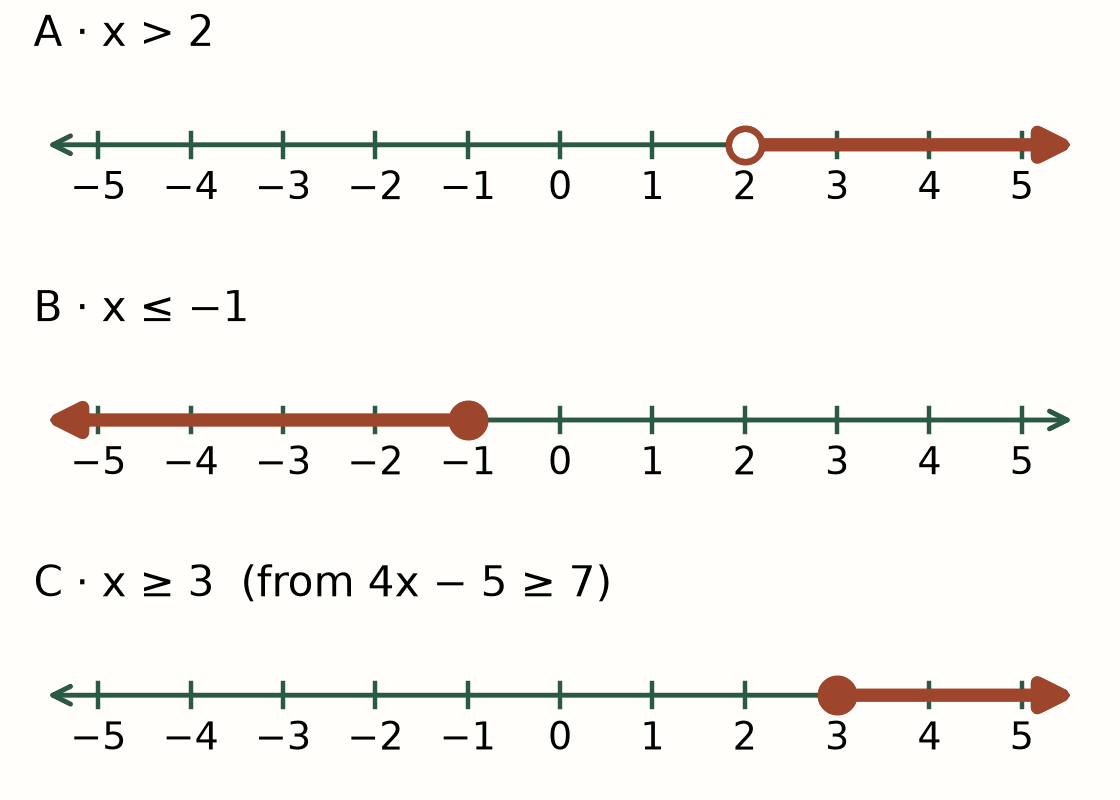
| Line | Dot | Shade | Examples that work |
|---|---|---|---|
| A: x > 2 | Open at 2 | Right | 2.5, 3, 10 |
| B: x ≤ −1 | Filled at −1 | Left | −1, −2, −4.5 |
| C: x ≥ 3 | Filled at 3 | Right | 3, 3.5, 8 |
An inequality has many answers
An equation such as x + 3 = 7 has one answer: x = 4. An inequality such as x + 3 < 7 is true for many numbers. The numbers 3, 0, −10 and 3.9 all work, because each one plus 3 is less than 7. The number 4 does not work, because 4 + 3 is exactly 7, and 7 is not less than 7.
There are four symbols to know. The symbol < means “is less than” and > means “is greater than.” The symbol ≤ means “is less than or equal to” and ≥ means “is greater than or equal to.” The extra bar under ≤ and ≥ is the “or equal to” part. One way to remember < and >: the small, pointed end always points at the smaller number, as in 2 < 5 and 9 > 1.
Turn everyday words into symbols
Limits in real life often hide inside words. “At least 18” means 18 or more, so it is ≥ 18. “No more than $40” and “at most $40” both mean $40 or less, so they are ≤ 40. “More than 3 hours” is > 3, and “fewer than 10 people” is < 10.
Watch out for “at least.” The word “least” sounds like “less,” but “at least 18” sets the lowest allowed value, so the answers are 18 and every number above it. Ask yourself two questions: is the boundary number itself allowed, and do the answers go up or down from it?
Solve it like an equation
You can solve an inequality with the same balancing moves you use for an equation. Add or subtract the same number on both sides, and multiply or divide both sides by the same positive number. These moves keep the inequality true.
Example: solve 3x − 4 < 11. Add 4 to both sides: 3x < 15. Divide both sides by 3: x < 5. Now check with a number that should work, such as 0: 3(0) − 4 = −4, and −4 < 11 is true. Then check one that should not work, such as 6: 3(6) − 4 = 14, and 14 < 11 is false. Both checks agree with x < 5.
Flip the sign when you multiply or divide by a negative
There is one extra rule. When you multiply or divide both sides by a negative number, reverse the direction of the symbol. Here is why. The statement 2 < 5 is true. Multiply both sides by −1 and you get −2 and −5. On a number line, −2 is to the right of −5, so −2 > −5. The order switched, so the symbol must switch too.
Example: solve −2x + 5 ≥ 11. Subtract 5 from both sides: −2x ≥ 6. Divide both sides by −2 and flip ≥ to ≤: x ≤ −3. Check with −4: −2(−4) + 5 = 8 + 5 = 13, and 13 ≥ 11 is true. Check with 0: −2(0) + 5 = 5, and 5 ≥ 11 is false. The answer x ≤ −3 passes both checks.
Only multiplying or dividing by a negative number flips the sign. Adding or subtracting a negative number does not. A negative answer, such as x ≤ −3, is not a reason to flip either.
Show the answer on a number line
A number line graph shows every number that works. First, put a dot at the boundary number. Use an open (empty) dot for < or >, because the boundary is not included. Use a filled dot for ≤ or ≥, because the boundary is included. Next, shade the side where the answers are: shade left for smaller numbers and right for larger numbers.
In the diagrams, Line A shows x > 2: an open dot at 2, shaded right. Line B shows x ≤ −1: a filled dot at −1, shaded left. Line C shows x ≥ 3, the answer to 4x − 5 ≥ 7 (add 5 to get 4x ≥ 12, then divide by 4). When x is written on the left side, the symbol points the way to shade: x < 4 points left, x > 4 points right. If x is on the right side, as in 4 > x, rewrite it as x < 4 first. Before you finish, pick one number in the shaded part and test it in the original inequality.
Use an inequality for a real limit
Dana has at most $60 for a phone plan. The plan costs $25 a month plus $5 for each extra gigabyte of data. Let g be the number of extra gigabytes. Her cost must be no more than $60: 25 + 5g ≤ 60. Subtract 25: 5g ≤ 35. Divide by 5: g ≤ 7. Dana can buy at most 7 extra gigabytes. Check: 25 + 5(7) = 25 + 35 = 60, exactly her limit.
In real problems, read the answer back into the story. You cannot buy a negative number of gigabytes, so here the answers are 0 through 7. If an answer must be a whole number, think about which way to round. For a “no more than” limit such as g ≤ 7.4, round down to 7, because 8 would go over. For an “at least” goal such as h ≥ 12.5 hours, round up to 13, because 12 would fall short.
Where this comes from
Where this comes from: GED Testing Service’s Assessment Guide for Educators: Mathematical Reasoning lists linear inequalities as assessment target A.3, “write, manipulate, solve, and graph linear inequalities.” Its four indicators cover solving one-variable inequalities with rational-number coefficients (A.3.a), identifying or graphing the solution on a number line (A.3.b), solving real-world problems (A.3.c), and writing an inequality from a situation (A.3.d). The guide places these targets in algebraic problem solving, which it says is about 55 percent of the GED® Mathematical Reasoning test. We checked the guide on October 20, 2026.
These sources set the topic. The explanations, diagrams and questions here are original FinishHigh practice, not GED® test questions. GED® is a registered trademark of the American Council on Education. FinishHigh is independent and not affiliated with or endorsed by it. This lesson teaches one starting skill. It is not a full course or an official readiness result.
Next, try the questions below. If balancing still feels shaky, review the lesson “Solve a simple equation one step at a time” first. Write down one mistake you fixed so you can check it again tomorrow.
Your turn.
Try each question before opening the explanation. These are FinishHigh practice examples, not GED® test questions.
A car-rental counter says drivers must be at least 21 years old. Write an inequality for the allowed ages a.
Show the answer and why
a ≥ 21. “At least 21” means 21 or older, so 21 itself is allowed. That is why the symbol has the “or equal to” bar.
Solve 2x + 7 < 19. Then check your answer with one number.
Show the answer and why
x is less than 6. Subtract 7 from both sides to get 2x is less than 12, then divide both sides by 2. Check with 0: 2(0) + 7 = 7, and 7 is less than 19, so 0 works. The number 6 does not work, because 2(6) + 7 = 19, and 19 is not less than 19.
Solve −3x ≥ 12.
Show the answer and why
x ≤ −4. Divide both sides by −3. Because you divided by a negative number, flip ≥ to ≤. Check with −5: −3(−5) = 15, and 15 ≥ 12 is true. Check with 0: −3(0) = 0, and 0 ≥ 12 is false, so 0 is correctly left out.
Solve 5 − x ≤ 2.
Show the answer and why
x ≥ 3. Subtract 5 from both sides: −x ≤ −3. Multiply both sides by −1 and flip the sign: x ≥ 3. Check with 4: 5 − 4 = 1, and 1 ≤ 2 is true. Check with 3: 5 − 3 = 2, and 2 ≤ 2 is true, so 3 is included.
Describe the number-line graph of x > −2. What kind of dot do you use, where does it go, and which way do you shade?
Show the answer and why
Use an open dot at −2 and shade to the right. The dot is open because −2 is not greater than itself. Shade right because numbers such as −1, 0 and 5 are all greater than −2.
A number-line graph has a filled dot at 4 and is shaded to the left. Write the inequality it shows.
Show the answer and why
x ≤ 4. The filled dot means 4 is included. Shading to the left means every smaller number also works, such as 3, 0 and −7.
A moving van costs $40 plus $0.50 per mile. Ray can spend no more than $85. Write and solve an inequality for the number of miles m he can drive.
Show the answer and why
40 + 0.50m ≤ 85, so m ≤ 90. Subtract 40 from both sides: 0.50m ≤ 45. Divide both sides by 0.50: m ≤ 90. Ray can drive at most 90 miles. Check: 40 + 0.50(90) = 40 + 45 = 85, exactly his limit.
Trusted sources and further study
Sources guide the topics and factual information. The lesson wording, examples, and questions are original FinishHigh material.
- Math: GED® test topic guidance ↗GED Testing Service · checked 2026-10-14
- Math: official assessment targets for educators ↗GED Testing Service · checked 2026-10-21
Another small step
Independent practice, not the GED® test or a pass guarantee. Aid and admission depend on the provider’s rules.
Choose your next free lesson ↗