Solve a system of two linear equations
Find the one pair of numbers that makes two equations true at once: by reading a graph, by substitution and by elimination. Then set up a system from a ticket or price story. Includes seven original questions with worked answers.
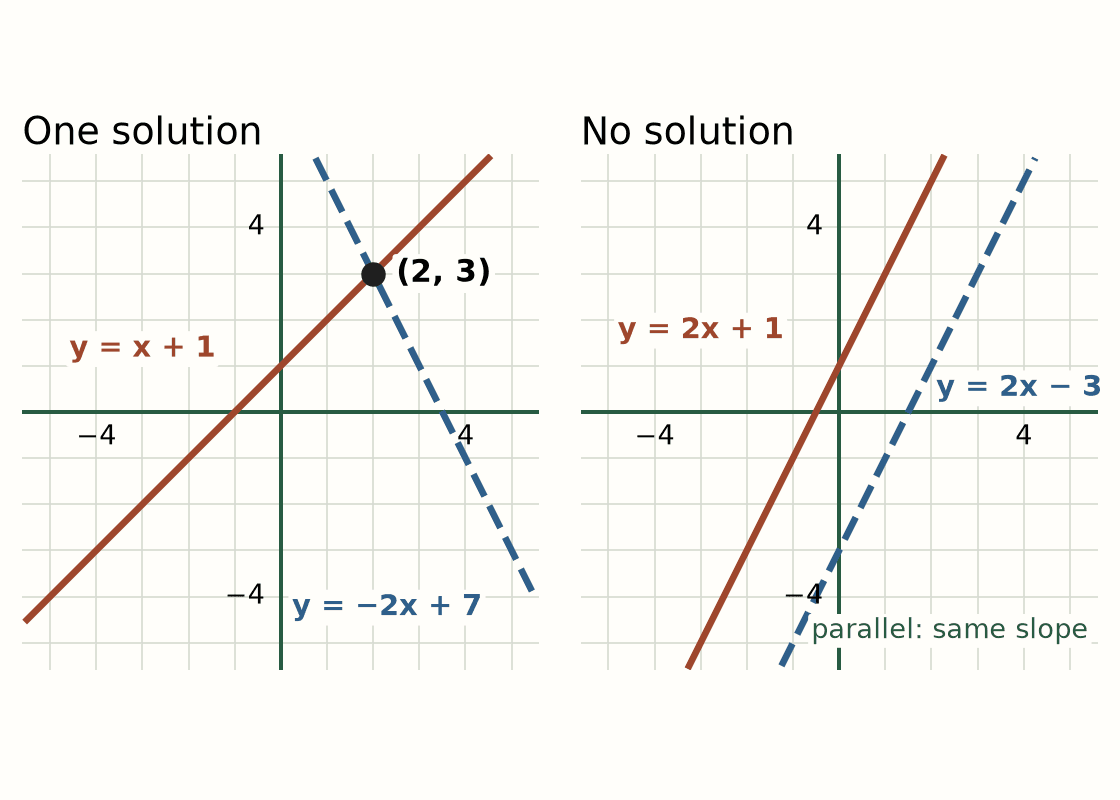
| Graph | Lines | What it means |
|---|---|---|
| Left | y = x + 1 and y = −2x + 7 | They cross at (2, 3), so the system has one solution: x = 2, y = 3 |
| Right | y = 2x + 1 and y = 2x − 3 | Same slope, different y-intercepts: the lines never cross, so there is no solution |
| Not drawn | y = 2x + 1 and 2y = 4x + 2 | Both are the same line, so every point on it is a solution |
What a system of equations is
A system is two equations that share the same two unknowns. Solving it means finding the pair of numbers, x and y, that makes both equations true at the same time. We write the answer as an ordered pair (x, y).
Example: x + y = 10 and x − y = 4. Many pairs add to 10, such as (5, 5) and (8, 2). Only one of them also has a difference of 4: (7, 3). Check both: 7 + 3 = 10 and 7 − 3 = 4. Always check your pair in both equations, not just one.
Solve by graphing
Each linear equation is a line. A point that is on both lines makes both equations true, so the solution is where the lines cross. In the left-hand diagram, y = x + 1 and y = −2x + 7 cross at (2, 3). Check: 2 + 1 = 3, and −2(2) + 7 = 3.
Two other things can happen. If the lines have the same slope but different y-intercepts, they are parallel and never cross, so there is no solution (right-hand diagram). If the two equations are really the same line, such as y = 2x + 1 and 2y = 4x + 2, every point on the line works, so there are infinitely many solutions.
Graphs are good for seeing the answer, but a crossing point can be hard to read exactly. The next two methods give exact answers.
Solve by substitution
Substitution works well when one equation already says “y = …” or “x = ….” Replace that letter in the other equation with what it equals. Then you have one equation with one unknown.
Example: y = 2x − 1 and 3x + y = 14. Put 2x − 1 in place of y: 3x + (2x − 1) = 14. Combine: 5x − 1 = 14, so 5x = 15 and x = 3. Then y = 2(3) − 1 = 5. The solution is (3, 5). Check in the second equation: 3(3) + 5 = 14.
Solve by elimination
Elimination (also called linear combination) adds or subtracts the two equations so that one letter cancels out. It works well when both equations look like ax + by = c.
Example: 2x + 3y = 12 and 4x − 3y = 6. The +3y and −3y cancel if you add the equations: 6x = 18, so x = 3. Put x = 3 into the first equation: 6 + 3y = 12, so 3y = 6 and y = 2. The solution is (3, 2). Check: 4(3) − 3(2) = 12 − 6 = 6.
Sometimes no terms cancel yet. Multiply one equation first. For x + 2y = 8 and 3x + y = 9, multiply the first equation by 3 to get 3x + 6y = 24. Subtract the second equation: (3x + 6y) − (3x + y) = 24 − 9, so 5y = 15 and y = 3. Then x + 2(3) = 8, so x = 2. Check: 3(2) + 3 = 9. Multiply every term, including the number after the equals sign.
Set up a system from a story
Many word problems hide a system. A common type has one equation that counts things and one that counts money. Example: a school play sells adult tickets for $12 and child tickets for $8. It sells 20 tickets for $200 in total. How many of each?
Let a be adult tickets and c be child tickets. Counting tickets: a + c = 20. Counting money: 12a + 8c = 200. From the first equation, a = 20 − c. Substitute: 12(20 − c) + 8c = 200, so 240 − 12c + 8c = 200, then −4c = −40 and c = 10. So a = 10. Check: 10 + 10 = 20 tickets and 12(10) + 8(10) = 120 + 80 = $200.
Before you solve, say in words what each letter stands for. After you solve, check that the answers make sense in the story; you cannot sell half a ticket or a negative number of tickets.
Where this comes from
Where this comes from: GED Testing Service’s Assessment Guide for Educators: Mathematical Reasoning lists target A.2, “write, manipulate, and solve linear equations.” Its indicator A.2.d covers solving a system of two linear equations by graphing, substitution or linear combination, and solving real-world problems that lead to a system. The guide places expressions and equations at about 30 percent of the GED® Mathematical Reasoning test, within the algebraic half of about 55 percent. We checked the guide on October 20, 2026.
These sources set the topic. The explanations, diagrams and questions here are original FinishHigh practice, not GED® test questions. GED® is a registered trademark of the American Council on Education. FinishHigh is independent and not affiliated with or endorsed by it. This lesson teaches one starting skill. It is not a full course or an official readiness result.
Next, try the questions below. If solving one equation still feels shaky, review the lesson “Solve a simple equation one step at a time” first. Write down one mistake you fixed so you can check it again tomorrow.
Your turn.
Try each question before opening the explanation. These are FinishHigh practice examples, not GED® test questions.
Is (4, 1) a solution of the system x + y = 5 and 2x − y = 7? Explain.
Show the answer and why
Yes. Check the first equation: 4 + 1 = 5, true. Check the second: 2(4) − 1 = 8 − 1 = 7, true. It works in both equations, so it is a solution.
Solve by substitution: y = x + 2 and 2x + y = 11.
Show the answer and why
(3, 5). Put x + 2 in place of y: 2x + x + 2 = 11, so 3x = 9 and x = 3. Then y = 3 + 2 = 5. Check: 2(3) + 5 = 11.
Solve by elimination: x + y = 9 and x − y = 3.
Show the answer and why
(6, 3). Add the equations: the y terms cancel, so 2x = 12 and x = 6. Then 6 + y = 9, so y = 3. Check: 6 − 3 = 3.
Solve: 3x + 2y = 16 and x − 2y = 0.
Show the answer and why
(4, 2). Add the equations: 4x = 16, so x = 4. Then 4 − 2y = 0, so y = 2. Check: 3(4) + 2(2) = 12 + 4 = 16.
Solve: 2x + y = 7 and 3x + 2y = 12.
Show the answer and why
(2, 3). Multiply the first equation by 2: 4x + 2y = 14. Subtract the second equation: (4x + 2y) − (3x + 2y) = 14 − 12, so x = 2. Then 2(2) + y = 7, so y = 3. Check: 3(2) + 2(3) = 12.
How many solutions does the system y = 3x + 4 and y = 3x − 1 have? Explain without solving.
Show the answer and why
None. Both lines have slope 3, but their y-intercepts are different (4 and −1). Lines with the same slope and different intercepts are parallel and never cross.
A coffee stand sells small coffees for $3 and large coffees for $5. One morning it sold 40 coffees for $164. How many of each size did it sell?
Show the answer and why
18 small and 22 large. Let s be small and l be large: s + l = 40 and 3s + 5l = 164. Substitute s = 40 − l: 3(40 − l) + 5l = 164, so 120 + 2l = 164, then 2l = 44 and l = 22. So s = 18. Check: 18 + 22 = 40 and 3(18) + 5(22) = 54 + 110 = 164.
Trusted sources and further study
Sources guide the topics and factual information. The lesson wording, examples, and questions are original FinishHigh material.
- Math: GED® test topic guidance ↗GED Testing Service · checked 2026-10-14
- Math: official assessment targets for educators ↗GED Testing Service · checked 2026-10-21
Another small step
Independent practice, not the GED® test or a pass guarantee. Aid and admission depend on the provider’s rules.
Choose your next free lesson ↗