Write a 45-minute evidence essay, step by step
A minute-by-minute plan for the GED® language arts test written response: read two sources, decide which argument is better supported, plan, write and check. Includes five practice tasks with model answers and four new practice prompts in the Writing Lab.
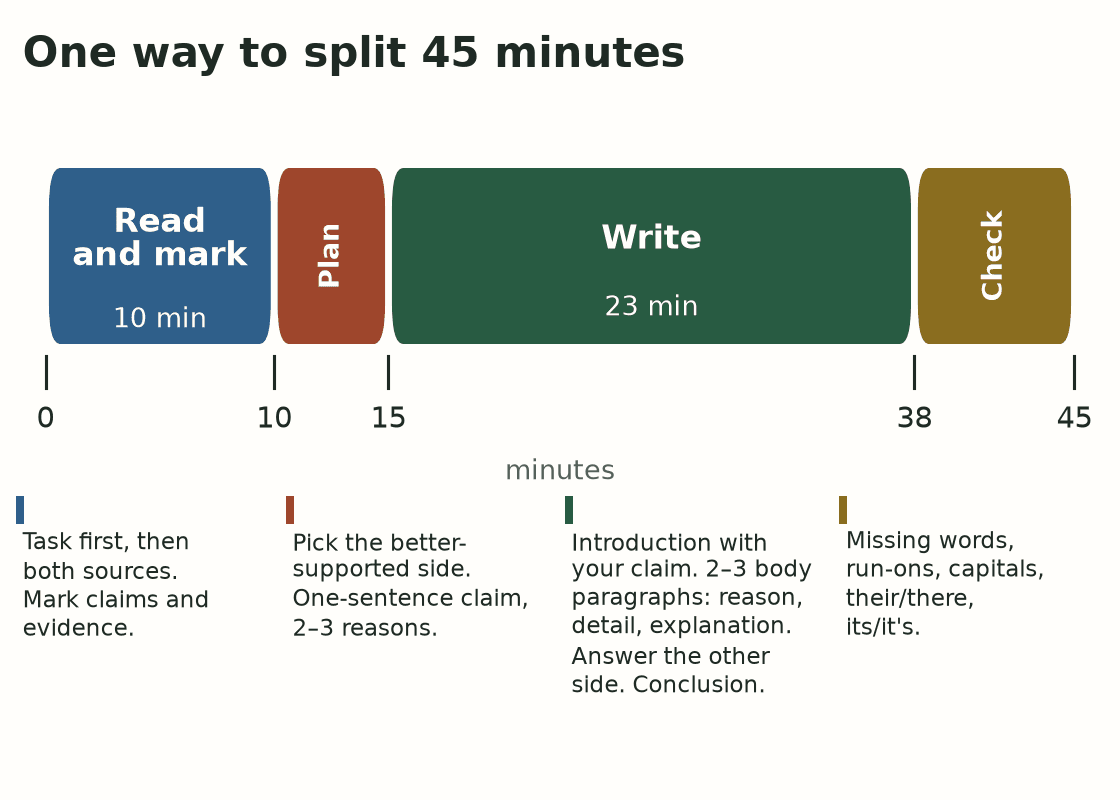
| Step | Minutes | What you do |
|---|---|---|
| 1. Read and mark | 0 to 10 | Read the task first, then both sources. Mark each claim and each piece of evidence. |
| 2. Decide and plan | 10 to 15 | Pick the better-supported side. Write a one-sentence claim and list two or three reasons. |
| 3. Write | 15 to 38 | Introduction with your claim, two or three body paragraphs, a short conclusion. |
| 4. Check and fix | 38 to 45 | Reread for missing words, run-ons, capital letters and commonly confused words. |
What the written response asks you to do
The GED® language arts test includes one written response, also called the extended response or essay. You get 45 minutes to read two short sources on the same issue, write an essay and check it. The sources often take opposite sides. Together they are no more than 650 words.
Your job is not to give your own opinion of the issue. Your job is to decide which source makes the better-supported argument and to show why, using details from both sources. You can personally disagree with the side you pick. What counts is the evidence.
GED Testing Service describes three traits that scorers look for: how well you build an argument and use evidence from the sources; how well you develop and organize your ideas; and how clearly you write, with mostly correct grammar, spelling and punctuation. Each trait is scored from 0 to 2. The plan below gives each trait its own time.
Minutes 0 to 10: read the task first, then mark the evidence
Read the task before the sources, so you know what to look for. Then read Source A and Source B. For each source, find the main claim: the one thing the writer wants you to accept. Write it in a few words on your scratch paper, such as "A: free buses for a 2-year trial."
Next, mark each piece of support and name what kind it is. A count or record from a named source ("fare-box records show $2.1 million") is usually strong. A plan that admits its own limits is a good sign. A personal story, "everyone I talk to," or a big prediction with no numbers ("taxes will double") is weaker. A story can still be real and important. It just cannot show what is true for a whole city.
Also watch for two common traps. One is treating things that happen together as cause and effect: "students who work long hours have lower grades, so work causes low grades." The other is a slippery slope: "if we allow this trial, it will become permanent forever."
Minutes 10 to 15: decide and plan
Pick the source with better support. Then write one sentence that will become your thesis, the main claim of your essay. A useful pattern is: "Source A makes the better-supported argument because it uses ___, while Source B relies on ___."
Under the thesis, list two or three reasons, each tied to a detail you marked. Then write down the best point the other side makes. Five minutes of planning feels slow, but it saves time later because you will not stop to figure out what to say next.
Minutes 15 to 38: write in four to six paragraphs
Introduction (two to four sentences): name the issue and both positions, then state your thesis. Do not start with a long story or a question.
Body paragraphs (two or three): start each with a sentence that gives one reason. Then quote or put a specific detail from a source into your own words, and explain why it is strong or weak support. The explanation is the part many writers skip. A detail without an explanation is only a summary. Ask yourself: what does this detail prove, and what does it fail to prove?
Answer the other side: in one paragraph, or inside a body paragraph, admit the best point the weaker source makes, then explain why it does not outweigh the evidence on your side. This shows you read both sources carefully.
Conclusion (two or three sentences): restate your claim in new words and remind the reader of your strongest reason. Do not add a new argument here.
Minutes 38 to 45: check and fix
Read your essay once, slowly, as if you were seeing it for the first time. Fix missing words first, because they confuse the reader most. Then check for run-on sentences, capital letters at the start of sentences and for names, and words that are easy to mix up, such as their, there and they're, or its and it's.
Scorers look for mostly correct writing, not perfect writing. A few small mistakes will not ruin a clear, well-supported essay, but many errors can make your ideas hard to follow.
A worked example: thesis and one body paragraph
This example uses the fare-free bus prompt in the FinishHigh Writing Lab. The city, numbers and people in that prompt are invented for practice. Thesis: "Source A, the transit office memo, makes the better-supported argument because it uses its own records and a clear plan to test fare-free buses, while Source B relies mostly on personal opinions and predictions."
Body paragraph: "Source A backs up its claim with numbers it can check. It says fares brought in $2.1 million, but collecting them cost about $600,000, so fares added only about 13 cents of every dollar the city spends on buses. It also timed 400 stops and found that boarding without paying took 21 seconds instead of 38. These details matter because they show the real cost of fares, not just the price of a ticket. In contrast, Source B says taxes will 'double' but never explains how a $1.5 million gap in an $11.7 million bus budget could do that."
Notice the pattern: reason, detail, explanation, and a comparison with the other source. A full essay would also admit Source B's fair point, that the state grant lasts only two years, and explain that Source A's plan to report every six months and bring fares back if needed answers that worry.
Practice in the Writing Lab: automated practice feedback only
The FinishHigh Writing Lab now has four new practice prompts, each with two original paired passages of about 550 to 650 words in all: fare-free buses, work-hour limits for students, a college placement test, and a weekend walking street. All of the places, people and numbers in them are invented.
When you submit an essay there, you get automated practice feedback only. A computer program checks simple signals, such as length, paragraphs, transition words and whether you mention the sources. It does not read for meaning the way a trained GED® test scorer does, and its practice score is not a GED® test score or a prediction of one. FinishHigh is not a writing service: nobody writes, edits or grades your essay for you, and there is no human tutoring. To get a person's feedback, ask a teacher at a local adult education program.
Where this comes from
Where this comes from: GED Testing Service's Assessment Guide for Educators: Reasoning Through Language Arts lists three writing targets. W.1 is to find what a text says outright and to make logical inferences and valid claims that fit the evidence. W.2 is to write an extended analytic response that states a clear claim, is logically organized, develops the claim with well-chosen details from the text and keeps a clear focus. W.3 is to write clearly with sufficient command of standard English conventions, which the guide explains as mostly correct, not perfect. The guide describes the 45-minute extended response, two source texts of no more than 650 words in total, and three traits each scored from 0 to 2. GED.com's test subjects page also lists 45 minutes for the written essay within the language arts test. We checked both on October 20, 2026.
These sources set the topic. The explanations, timeline, passages and questions here are original FinishHigh practice, not GED® test questions, prompts or scored samples. GED® is a registered trademark of the American Council on Education. FinishHigh is independent and not affiliated with or endorsed by it. This lesson teaches one skill. It is not a full course or an official readiness result.
Next, try the five tasks below. If comparing two arguments still feels new, review the lesson "Which argument has stronger evidence?" first. Then write one timed essay in the Writing Lab, and note one step of the plan you want to do better next time.
Your turn.
Try each question before opening the explanation. These are FinishHigh practice examples, not GED® test questions.
Task 1 (read and mark). A short source says: "Our library should open on Sundays. Last year, 1,100 people signed a petition asking for Sunday hours, and the library's records show its computers are fully booked every Saturday." What is the claim, and what two pieces of evidence support it?
Show the answer and why
The claim is that the library should open on Sundays. The evidence is (1) the petition with 1,100 signatures, which shows that many people want Sunday hours, and (2) the library's own records that Saturday computer time is fully booked, which suggests there is more demand than the current hours meet. Both are specific and come from a named source, so they are fairly strong support.
Task 2 (name the evidence type). Label each detail as a record or count, an expert's statement, a personal story, or an unsupported prediction: (a) "My cousin got sick after eating there." (b) "The health department's inspection report lists three violations." (c) "Business will collapse within a year." (d) "A food-safety scientist at the state university said the cooler temperature was unsafe."
Show the answer and why
(a) Personal story: real for one person, but it cannot show a pattern. (b) Record from a named source: strong. (c) Unsupported prediction: no numbers or reasons are given. (d) Expert's statement: fairly strong, because the speaker has relevant training and the claim is specific.
Task 3 (write a thesis). Source A, a school report, uses attendance records from two years to argue for a later start time. Source B, a parent's letter, argues against it because "kids will just stay up later." Write a one-sentence thesis for an essay about which argument is better supported.
Show the answer and why
One model: "Source A makes the better-supported argument for a later start time because it relies on two years of attendance records, while Source B offers only a prediction about student behavior with no evidence behind it." A strong thesis names the better-supported source, names its kind of evidence, and names the weakness in the other source.
Task 4 (add the explanation). This body paragraph only summarizes. Add one or two sentences that explain why the detail matters: "Source A says the city's sidewalk counters recorded 5,800 people a day on the closed weekends and 3,900 a day before. Source B says parking is impossible."
Show the answer and why
One model addition: "This count matters because it comes from the city's own counters, not from the merchants' opinions, and it shows about 1,900 more people a day on the street. Source B's complaint about parking may be true for some drivers, but it gives no count of lost visitors, so it does not outweigh a measured increase." A good explanation says what the detail proves and why it is stronger or weaker than the other side.
Task 5 (check and fix). Find and fix the errors in this sentence: "the transit office have a plan, they will report to the city council every six months and bring back fares if its not working."
Show the answer and why
Corrected: "The transit office has a plan. It will report to the city council every six months and bring back fares if it's not working." Fixes: capital T to start the sentence; "has" because "office" is singular; the comma splice is split into two sentences (a semicolon also works); "they" becomes "it" to match "office"; and "its" becomes "it's," short for "it is."
Trusted sources and further study
Sources guide the topics and factual information. The lesson wording, examples, and questions are original FinishHigh material.
- The four GED® test subjects ↗GED Testing Service · checked 2026-10-07
- Extended response quick tips ↗GED Testing Service · checked 2026-10-07
- GED® test: language arts extended-response resources ↗GED Testing Service · checked 2026-10-16
- Language arts: official assessment targets for educators ↗GED Testing Service · checked 2026-10-20
Another small step
Independent practice, not the GED® test or a pass guarantee. Aid and admission depend on the provider’s rules.
Choose your next free lesson ↗