Understand matter, chemical reactions and solutions
Learn what atoms, elements, compounds and mixtures are, how to read a chemical formula, the difference between physical and chemical changes, density, how to balance a chemical equation and why mass is conserved, limiting reactants, reaction types, heat in reactions, and how solutions and solubility work. Includes eight original questions with worked answers.
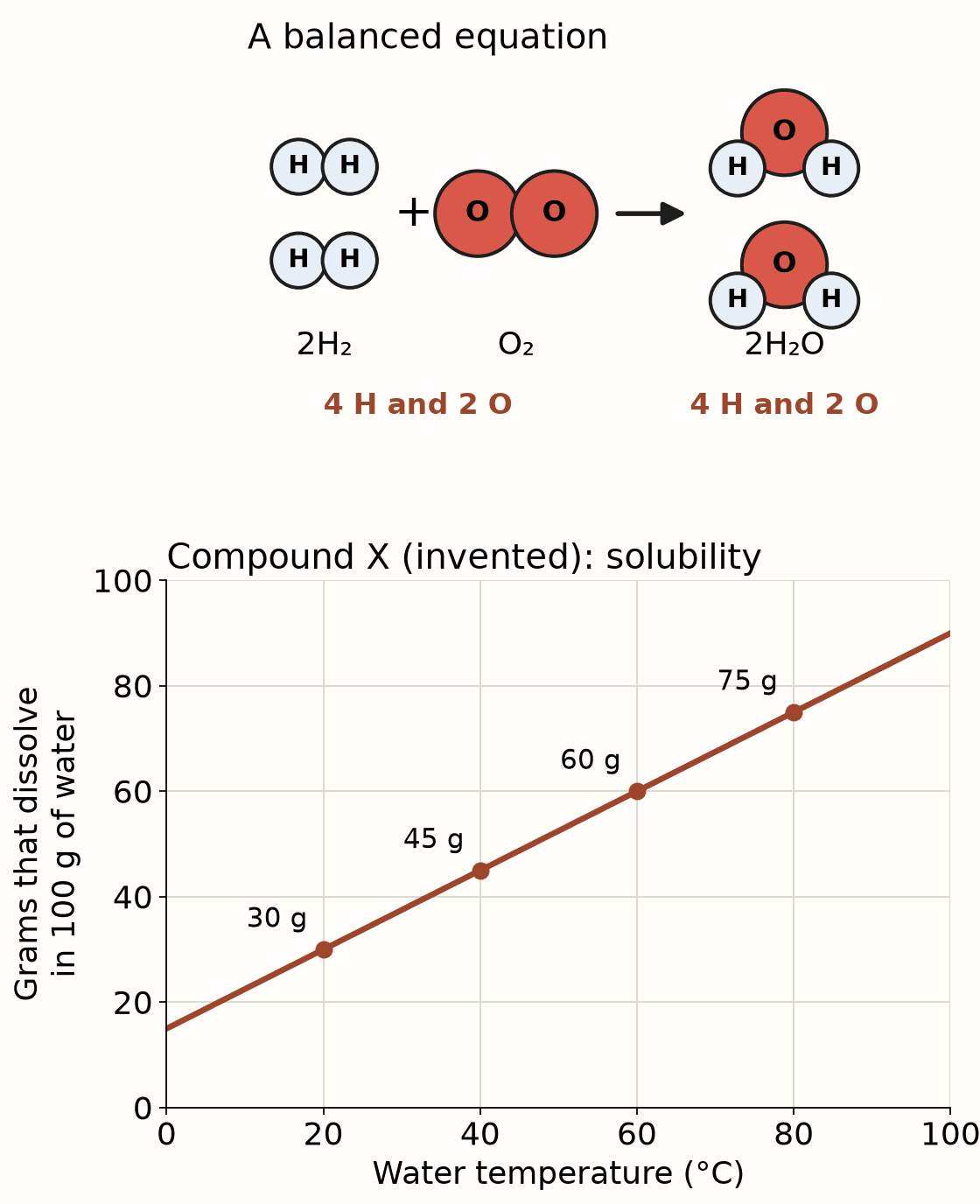
| Figure | What it shows | Key fact |
|---|---|---|
| Balanced equation | 2H₂ + O₂ → 2H₂O | 4 H and 2 O atoms on each side, so mass is conserved |
| Compound X solubility | Grams that dissolve in 100 g of water: 30 g at 20 °C, 45 g at 40 °C, 60 g at 60 °C, 75 g at 80 °C | Hotter water dissolves more of this solid |
What matter is made of
Matter is anything that has mass and takes up space. All matter is made of atoms. An atom has a nucleus with protons (positive charge) and neutrons (no charge), and electrons (negative charge) that move around the nucleus.
An element is a substance made of only one kind of atom, such as oxygen (O) or iron (Fe). The number of protons decides the element; that number is the atomic number on the periodic table.
A compound is two or more elements chemically joined in a fixed ratio, such as water (H₂O). A mixture is substances mixed together but not chemically joined, such as salt water or trail mix; you can often separate a mixture by filtering, boiling or picking it apart.
Read a chemical formula like a recipe. In H₂O, the small 2 (a subscript) means 2 hydrogen atoms; O with no number means 1 oxygen atom. CO₂ has 1 carbon and 2 oxygen atoms. A big number in front, as in 3H₂O, counts whole molecules: 3 molecules, so 6 H and 3 O.
Physical and chemical changes
A physical property can be observed without making a new substance: color, mass, hardness, melting point, boiling point, density, whether it dissolves. A chemical property describes how a substance reacts, such as whether it burns or rusts.
In a physical change, the substance stays the same substance. Melting, freezing, boiling, cutting and dissolving sugar in water are physical changes. The states of matter are solid (fixed shape), liquid (takes the shape of its container) and gas (fills its container).
In a chemical change (a chemical reaction), new substances form. Signs include a gas forming (bubbles) when two substances mix, a solid forming from two liquids, a color change that cannot be undone easily, light, or a change in temperature. Burning wood, rusting iron and baking bread are chemical changes.
Density
Density tells how much mass is packed into a volume: density = mass ÷ volume. It is often written in grams per cubic centimeter (g/cm³) or grams per milliliter (g/mL); 1 mL equals 1 cm³.
Example: a metal bar has a mass of 54 grams and a volume of 20 cm³. Its density is 54 ÷ 20 = 2.7 g/cm³.
Water's density is about 1 g/cm³. An object denser than the liquid sinks; one less dense floats. The bar (2.7) sinks in water. A block of wood with 0.6 g/cm³ floats. Density stays the same however big a piece you cut, because mass and volume change together.
Chemical equations and conservation of mass
A chemical equation shows a reaction. The starting substances, the reactants, go on the left. The new substances, the products, go on the right. The arrow means “react to form.”
Atoms are not created or destroyed in a reaction; they are rearranged. So a balanced equation has the same number of each kind of atom on both sides. That is why mass is conserved: the total mass of the products equals the total mass of the reactants.
To balance, change only the big numbers in front (coefficients), never the small subscripts, because changing a subscript makes a different substance. Example: H₂ + O₂ → H₂O has 2 O on the left but 1 on the right. Put 2 in front of H₂O: now 4 H on the right, so put 2 in front of H₂. The balanced equation is 2H₂ + O₂ → 2H₂O, with 4 H and 2 O on each side, as the figure shows.
Mass check: in a sealed container, if 4 grams of hydrogen react completely with 32 grams of oxygen, 36 grams of water form. In an open container, a gas product can escape into the air, so a scale may show less mass, but the mass has not been destroyed.
Limiting reactants
A balanced equation is a recipe with fixed ratios. 2H₂ + O₂ → 2H₂O means 2 hydrogen molecules for every 1 oxygen molecule.
Suppose you have 6 H₂ molecules and 2 O₂ molecules. The 2 O₂ need 2 × 2 = 4 H₂. You have 6, so 2 H₂ are left over. Oxygen runs out first: it is the limiting reactant, and it makes 2 × 2 = 4 H₂O molecules. Hydrogen is in excess.
Think of sandwiches: with 10 slices of bread and 3 slices of cheese, and 2 bread plus 1 cheese per sandwich, you can make only 3 sandwiches. The cheese limits you, and 4 slices of bread are left.
Types of reactions, and heat
Synthesis: two or more substances combine into one, A + B → AB. Example: 2Mg + O₂ → 2MgO. Decomposition: one substance breaks apart, AB → A + B. Example: 2H₂O → 2H₂ + O₂.
Single replacement: one element takes the place of another in a compound, A + BC → AC + B. Double replacement: two compounds swap partners, AB + CD → AD + CB. Combustion: a fuel reacts with oxygen and gives off energy; when the fuel contains carbon and hydrogen, the products are carbon dioxide and water. Example: CH₄ + 2O₂ → CO₂ + 2H₂O.
Exothermic reactions release heat, so the surroundings get warmer: burning fuel, a hand warmer. Endothermic reactions and processes absorb heat, so the surroundings get colder: an instant cold pack, where a solid dissolving in water takes in heat. Ask which way the heat moves.
Solutions and solubility
A solution is a mixture that is the same all the way through. The solute is the substance that dissolves (sugar). The solvent does the dissolving (water). Together they make the solution (sugar water).
Solubility is the most solute that can dissolve in a set amount of solvent at a given temperature. For most solids, hotter water dissolves more. The graph of invented Compound X shows 30 grams per 100 grams of water at 20 °C and 60 grams at 60 °C. Gases are the other way around: they dissolve less in warm water, which is why a warm soda goes flat faster.
An unsaturated solution can still dissolve more solute. A saturated solution holds all it can at that temperature; extra solute sits on the bottom. If a saturated solution of Compound X at 60 °C (60 g in 100 g of water) cools to 20 °C, only 30 g can stay dissolved, so about 30 g comes out as solid.
A concentrated (strong) solution has a lot of solute in the solvent; a dilute (weak) solution has a little. Adding more solvent dilutes a solution.
Where this comes from
Where this comes from: GED Testing Service’s Assessment Guide for Educators: Science lists physical science content topic P.c, “Chemical Properties and Reactions Related to Living Systems”: P.c.1 structure of matter; P.c.2 physical and chemical properties, changes of state and density; P.c.3 balancing chemical equations and different types of chemical equations, conservation of mass in balanced chemical equations and limiting reactants; and P.c.4 parts in solutions, general rules of solubility, saturation and the differences between weak and strong solutions. Topic P.a.2 lists endothermic and exothermic reactions. The guide says about 40 percent of the GED® Science test focuses on physical science, that test-takers should be broadly familiar with these terms rather than know each one in depth, and that the test’s stimuli give the needed details about formulas and other key principles. We checked it on October 20, 2026.
These sources set the topic. The explanations, figures, data and questions here are original FinishHigh practice, not GED® test questions. GED® is a registered trademark of the American Council on Education. FinishHigh is independent and not affiliated with or endorsed by it. This lesson teaches one starting skill. It is not a full course or an official readiness result.
Next, try the questions below. When a question shows an equation, count the atoms on each side before you answer.
Your turn.
Try each question before opening the explanation. These are FinishHigh practice examples, not GED® test questions.
Glucose has the formula C₆H₁₂O₆. How many atoms of each element are in one molecule, and how many atoms in all?
Show the answer and why
6 carbon, 12 hydrogen and 6 oxygen atoms. 6 + 12 + 6 = 24 atoms in all.
Physical or chemical change? (a) ice melting (b) iron rusting (c) sugar dissolving in tea (d) bread baking
Show the answer and why
(a) Physical: it is still water. (b) Chemical: rust is a new substance. (c) Physical: the sugar is still sugar and the water can be boiled off to get it back. (d) Chemical: baking makes new substances, and you cannot unbake bread.
A stone has a mass of 150 grams and a volume of 60 cm³. A cork has a mass of 12 grams and a volume of 50 cm³. Find each density. Which floats in water?
Show the answer and why
Stone: 150 ÷ 60 = 2.5 g/cm³, more than water's 1 g/cm³, so it sinks. Cork: 12 ÷ 50 = 0.24 g/cm³, less than 1, so it floats.
Balance this equation: __ Mg + __ O₂ → __ MgO
Show the answer and why
2Mg + O₂ → 2MgO. The left has 2 O, so put 2 in front of MgO. That makes 2 Mg on the right, so put 2 in front of Mg. Check: 2 Mg and 2 O on each side.
In an open cup, two substances with a total mass of 80.0 grams are mixed. The mixture fizzes. Afterward the cup and its contents weigh 77.8 grams. Was mass destroyed?
Show the answer and why
No. Mass is conserved. The fizzing was a gas forming, and about 2.2 grams of gas escaped into the air. In a sealed container the scale would still read 80.0 grams.
N₂ + 3H₂ → 2NH₃. A container has 4 N₂ molecules and 9 H₂ molecules. Which is the limiting reactant? How many NH₃ molecules form, and what is left over?
Show the answer and why
Each N₂ needs 3 H₂. The 9 H₂ can react with only 9 ÷ 3 = 3 N₂, so hydrogen is the limiting reactant. 3 N₂ make 3 × 2 = 6 NH₃ molecules. 1 N₂ molecule is left over.
CH₄ + 2O₂ → CO₂ + 2H₂O. What type of reaction is this, and is it exothermic or endothermic? Then: an instant cold pack gets cold when squeezed. Is that process exothermic or endothermic?
Show the answer and why
Combustion: methane, a fuel, reacts with oxygen to make carbon dioxide and water. It is exothermic because it releases heat. The cold pack is endothermic: it absorbs heat from your hand and the air, so it feels cold.
Use the Compound X graph. How many grams dissolve in 200 grams of water at 60 °C? A solution has 50 grams dissolved in 100 grams of water at 60 °C: is it saturated?
Show the answer and why
120 grams: 60 grams per 100 grams of water, and 200 grams of water is twice as much. The 50-gram solution is unsaturated, because 100 grams of water at 60 °C can hold 60 grams; it could dissolve 10 grams more.
Trusted sources and further study
Sources guide the topics and factual information. The lesson wording, examples, and questions are original FinishHigh material.
- Science: official assessment targets for educators ↗GED Testing Service · checked 2026-10-20
Another small step
Independent practice, not the GED® test or a pass guarantee. Aid and admission depend on the provider’s rules.
Choose your next free lesson ↗